Historical background:
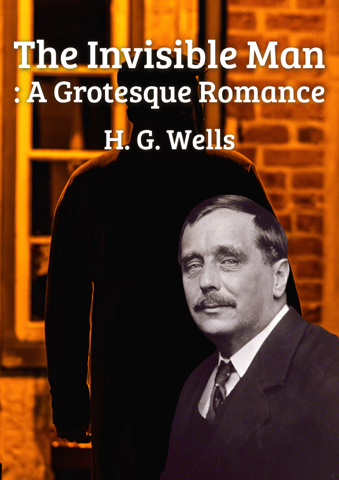
Published in 1897, Wells's scientific romance emerged when new physics, chemistry, and popular journalism made invisible forces a powerful imaginative subject. The subtitle 'A Grotesque Romance' signals that village comedy and bodily farce coexist with scientific terror.
Story introduction:
A bandaged stranger arrives in an English village carrying secret apparatus and refusing ordinary scrutiny. As his invisibility becomes known, the practical demands of food, clothing, movement, and recognition turn an apparent superpower into a social and ethical crisis.
Literary form:
Wells withholds Griffin's account until well into the novel, first letting villagers interpret fragments through gossip and physical comedy. The later confession changes scale and tone, exposing the labor of the experiment and the coercive ambitions behind it.
Central themes:
A bandaged stranger arrives in an English village carrying secret apparatus and refusing ordinary scrutiny. As his invisibility becomes known, the practical demands of food, clothing, movement, and recognition turn an apparent superpower into a social and ethical crisis. Beyond that immediate situation, The Invisible Man: A Grotesque Romance examines science fiction, invisibility, ethics, isolation, experiment, Victorian England. The novel is important to Wells's 1890s sequence of scientific romances because it tests an invention through material consequences. Its influence persists in horror and superhero fiction, but the book's distinctive question is social visibility: power without accountability rapidly destroys reciprocal life. Together, these concerns give the conflict its moral and historical weight beyond the immediate plot.
Director: James Whale
Production country: United States
Principal cast: Claude Rains, Gloria Stuart, William Harrigan
Why this version matters: This identifiable production provides a useful comparison between the selected text and a major screen interpretation associated with named filmmakers and performers.
Difference from the book: It adds a fiancée and makes a drug's side effects central to Griffin's escalating madness. The change affects point of view, pacing, or the balance among mystery, romance, horror, and social context; viewers should therefore treat the film as an interpretation rather than a visual substitute for the novel.
Screen interpretation:
The named adaptation adds a fiancée and makes a drug's side effects central to Griffin's escalating madness. For The Invisible Man: A Grotesque Romance, that choice changes the weight given to science fiction, invisibility, ethics, isolation, experiment, Victorian England: visible action replaces some of the prose’s control over voice and delay, while the performances give particular faces and bodies to relationships that the book can keep uncertain. The screen version therefore creates a distinct emphasis rooted in this work’s specific narrative problem.
Edition history:
presents the English original with a prologue and 28 chapters. Adaptations often add romance, an antidote, military conspiracy, or a sympathetic origin; readers should not import those inventions into Wells's sharper structure or confuse this text with audiobook record. Complete prose text; is the selected text rather than the separate audiobook record. The history of The Invisible Man: A Grotesque Romance is especially sensitive to its prologue and 28 chapters, because abridgment or revision can alter the balance among science fiction, invisibility, ethics, isolation, experiment, Victorian England.
Translation history:
The Invisible Man: A Grotesque Romance was written in en; this record uses the original-language text rather than a translation. Translations must recreate the book’s treatment of science fiction, invisibility, ethics, isolation, experiment, Victorian England, including differences of register, dialogue, and historically specific vocabulary that shape H. G. Wells’s effects.
Place in literary history:
The novel is important to Wells's 1890s sequence of scientific romances because it tests an invention through material consequences. Its influence persists in horror and superhero fiction, but the book's distinctive question is social visibility: power without accountability rapidly destroys reciprocal life.
Place in the author's career:
The novel is important to Wells's 1890s sequence of scientific romances because it tests an invention through material consequences. Its influence persists in horror and superhero fiction, but the book's distinctive question is social visibility: power without accountability rapidly destroys reciprocal life. Within H. G. Wells’s career, The Invisible Man: A Grotesque Romance is distinguished by an English scientific romance whose experiment in invisibility becomes a study of isolation, coercion, embodiment, and social breakdown. It gathers the author’s concerns into a structure where science fiction, invisibility, ethics, isolation, experiment, Victorian England interact instead of standing as separate messages.
Continuing influence:
The Invisible Man: A Grotesque Romance continues to influence later storytelling through its handling of science fiction, invisibility, ethics, isolation, experiment, Victorian England. The novel is important to Wells's 1890s sequence of scientific romances because it tests an invention through material consequences. Its influence persists in horror and superhero fiction, but the book's distinctive question is social visibility: power without accountability rapidly destroys reciprocal life. Its afterlife shows how a historically specific work can generate new interpretations while the original retains complications that simplified cultural versions leave aside.
Miva: the next reading experience beyond audiobooks
Listen like an audiobook, then ask anything, anytime.
Start Miva's narrationMiva does not just narrate. It keeps explaining based on what you ask.