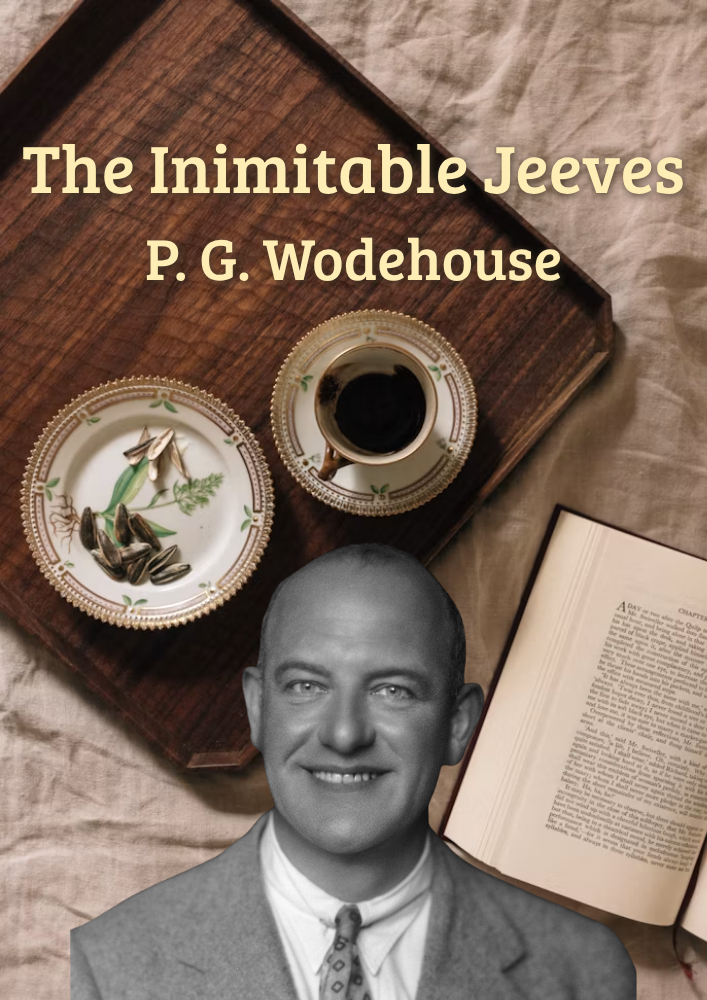
Background: British comedy writing during the interwar period often used aristocratic youth, clubs, country houses, and family pressures as its stage. Wodehouse transformed these elements into a series of misunderstandings with almost musical precision. The Inimitable Jeeves connects Jeeves, Wodehouse, British humor, social comedy, the interwar period, and linked short stories. Rather than treating the era as decorative background, it allows social shifts, class pressures, postwar spirit, and modern urbanity to permeate the characters' tones, choices, and silences. Readers can thus understand why this work resonated in its time and see the cultural questions it addresses.
Synopsis: Bertie Wooster's friend, Bingo Little, repeatedly falls in love, leading to a succession of spiraling engagements, aunts, horse races, and social scenes. Jeeves always manages to arrange an escape at the last moment, ending every absurdity with elegance. The story progresses not just through plot twists, but through the tension formed by character relationships, shifting perspectives, and the accumulation of scenes. Readers follow the main characters into dilemmas of romance, travel, family, and social or spiritual exploration, gradually seeing how surface order is pulled by desire, memory, duty, and misunderstanding. Core plots are preserved here while avoiding spoilers of the most critical endings.
Literary Features: Readers can see how Wodehouse strings short stories into a novelistic rhythm and appreciate the control of tone, timing, and repetitive variation in comedy fiction. This is a volume in the Jeeves series highly suited for reading aloud. Notably, the literary significance of The Inimitable Jeeves lies not in an abstract "classic" status, but in how it utilizes narrative rhythm, symbolic imagery, character voice, and structural arrangement to make loneliness, disillusionment, or spiritual crisis a palpable reading experience. It is also suitable for reading alongside other modernist, Jazz Age, and postwar literature to observe how different writers handled the individual within a fractured era.
Encyclopedia
Author Biography: P. G. Wodehouse (1881-1975) was a British humorist, playwright, and lyricist, most famous for the Jeeves and Wooster series. His works are built on misunderstandings, social disasters, class etiquette, romantic troubles, and precise reversals, written with a light yet highly sophisticated linguistic rhythm. Wodehouse's comedic world may seem far removed from the weight of politics and history, yet it preserves the musicality of British humor with supreme skill, allowing readers to feel the pleasure of order being rearranged amidst absurd situations. His creation belongs not just to the entries of literary masters but is frequently reread in university courses, book clubs, and cross-cultural discussions; the narrative forms, character psychology, and observations of the era continue to provide valid entry points for understanding modern life.
Relationship Between Author and Work: P. G. Wodehouse was able to write The Inimitable Jeeves due to the close link between his era, creative concerns, and literary ambitions. This work centralizes the author's long-term interests—Jeeves, British humor, social comedy, the interwar period, and linked short stories—and transforms them into readable experiences through specific characters and narrative forms. It is not a simple projection of the author's life, but the result of combining personal observation, the pressures of the times, and formal experimentation. Therefore, when reading this book, it is best to pay attention to both the author's background and how the text reforges that background into literary form.
Miva: the next reading experience beyond audiobooks
Listen like an audiobook, then ask anything, anytime.
Start Miva's narrationMiva does not just narrate. It keeps explaining based on what you ask.