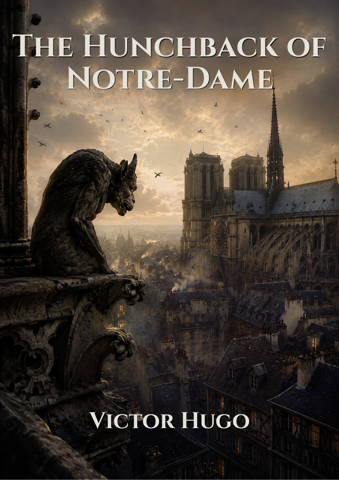
Introduction
Notre-Dame de Paris, known in English as The Hunchback of Notre-Dame, is a historical novel written by Victor Hugo and published in 1831.
It is one of the most famous works of 19th-century French literature and a masterpiece of the Romantic movement.
The story takes place in Paris in the 15th century, centered around the Notre-Dame Cathedral, which becomes almost a character in its own right in the novel. Hugo weaves together love, fate, social injustice, and a critique of religious and political institutions.
Story Summary
The novel tells the tragic fate of several characters:
Quasimodo, the deformed bell-ringer of Notre-Dame;
Esmeralda, a beautiful and innocent young Gypsy dancer;
Claude Frollo, the archdeacon tormented by an obsessive passion;
Phoebus de Châteaupers, a handsome but superficial captain.
Quasimodo falls deeply in love with Esmeralda, who loves Phoebus.
Frollo, consumed by jealousy and desire, triggers a series of tragic events that ultimately lead to Esmeralda's death.
The novel explores several themes:
beauty and monstrosity;
impossible love;
fate (fatum);
social exclusion;
the conflict between passion and religion.
Importance of the Cathedral
In this novel, Notre-Dame de Paris symbolizes:
the history of France;
the grandeur of the Middle Ages;
the soul of Paris.
At the time of Hugo's writing, the cathedral was in poor condition. Thanks to the success of the novel, public opinion became aware of the importance of preserving French Gothic heritage. The book directly contributed to the restoration of the cathedral in the 19th century.
Style and Influence
The novel fully belongs to French Romanticism:
grandiose descriptions;
intense emotions;
tragic characters;
fascination with the Middle Ages.
The work has inspired numerous adaptations:
films;
operas;
musicals;
cartoons.
The musical Notre-Dame de Paris has become world-famous.
Set in 1482 Paris, Victor Hugo's The Hunchback of Notre-Dame opens during the carnival Feast of Fools. The impoverished poet Pierre Gringoire tries to stage a moral play, but the crowd is distracted by the festive election of the Pope of Fools. Quasimodo, the horribly deformed, hunchbacked, and deaf bell-ringer of Notre-Dame Cathedral, is elected due to his physical appearance. Shortly after, Gringoire watches the captivating performance of Esmeralda, a beautiful Romani street dancer, and her clever goat, Djali. That night, Archdeacon Claude Frollo, a tormented priest obsessed with Esmeralda, attempts to abduct her with Quasimodo's assistance. Captain Phoebus de Châteaupers and his archers intervene, saving Esmeralda and arresting Quasimodo, though Phoebus merely views Esmeralda as a casual conquest. Following the incident, Gringoire wanders into the lawless Cour des Miracles, where he is captured by beggars and thieves. To save him from being hanged, Esmeralda agrees to marry him in a symbolic four-year union, though she maintains a platonic boundary and remains secretly enamored with Phoebus. Quasimodo is sentenced to public flogging on the pillory for the attempted abduction. As he endures torture and the taunts of the mob, he begs for water. Esmeralda steps forward and offers him a drink from her canteen. This singular act of genuine kindness deeply touches Quasimodo, awaking a intense, devoted loyalty within him. Meanwhile, Claude Frollo’s obsessive lust for Esmeralda consumes him. Learning that Esmeralda has arranged a secret romantic meeting with Phoebus at a local tavern, Frollo secretly follows them. Driven by mad jealousy as he spies on their intimate encounter, Frollo bursts from his hiding place and stabs Phoebus with a dagger before escaping out a window. Esmeralda faints and is discovered alone at the crime scene. Falsely accused of murder and witchcraft, Esmeralda is subjected to severe torture in court. Unable to bear the pain, she falsely confesses to the charges and is sentenced to death by hanging. Frollo visits her in her dungeon cell, offering to save her life if she agrees to give herself to him, but she rejects him with disgust. On the day of her public execution outside Notre-Dame, Quasimodo swings down on a rope from the cathedral's towers, swoops up Esmeralda, and carries her into the church while shouting "Sanctuary!" Under ecclesiastical law, she is protected from secular authorities as long as she remains inside. During her time in the cathedral, Quasimodo cares for Esmeralda, protecting her and bringing her food, though his terrifying appearance makes her uneasy. Frollo continues his relentless pursuit. Learning that the parliament intends to revoke the right of sanctuary to execute Esmeralda, Gringoire and Frollo manipulate the truands (the criminals of Paris) into launching a violent night assault on Notre-Dame to rescue her. Quasimodo, believing the mob intends to kill Esmeralda, single-handedly defends the cathedral by hurling timber, stones, and molten lead onto the attackers below. Amid the chaos, Frollo and Gringoire sneak into the cathedral and lead Esmeralda away. Frollo delivers her to the place de Grève and gives her a final choice: submit to his love or face the gallows. When she refuses him once more, Frollo turns her over to the troops and the recluse Gudule, who unexpectedly realizes Esmeralda is her long-lost daughter, though she is unable to save her from the executioners. From the high tower of Notre-Dame, Frollo watches with a cold smile as Esmeralda is hanged. Realizing the priest's role in her destruction, Quasimodo pushes Frollo off the balustrade to his death on the cobblestones below. Devastated by the loss of the two people he loved, Quasimodo disappears. Years later, workers unearth the vault at Montfaucon and discover two skeletons intertwined: one belonging to Esmeralda, and the other belonging to a deformed man whose spine was bent. When observers attempt to separate the skeletons, Quasimodo's bones crumble into dust.
Alas!” he said, “this will kill that.Original: — Hélas ! dit-il, ceci tuera cela.The Hunchback of Notre-Dame Livre Cinquième. This iconic statement encapsulates the novel's central theme regarding the monumental cultural shift from architectural tradition to the printed word.
She approached, without saying a word, the sufferer who was writhing in vain to escape her, and unfastening a canteen from her belt, she brought it gently to the wretched man’s parched lips.Original: Elle s’approcha, sans dire une parole, du patient qui se tordait vainement pour lui échapper, et, détachant une gourde de sa ceinture, elle la porta doucement aux lèvres arides du misérable.The Hunchback of Notre-Dame Livre Sixième. This act of pure compassion breaks through Quasimodo's isolation, bringing him to tears and marking the emotional core of the novel.
Quasimodo then raised his eye to the Gypsy girl whose body, suspended from the gallows, he saw shivering in the distance under her white dress in the last quivers of agony, then he lowered it again to the archdeacon lying at the foot of the tower and no longer retaining human form, and he said with a sob that shook his deep chestOriginal: Quasimodo alors releva son œil sur l’égyptienne dont il voyait le corps, suspendu au gibet, frémir au loin sous sa robe blanche des derniers tressaillements de l’agonie, puis il le rabaissa sur l’archidiacre étendu au bas de la tour et n’ayant plus forme humaine, et il dit avec un sanglot qui souleva sa profonde poitrineThe Hunchback of Notre-Dame. It captures the tragic climax of the story as Quasimodo witnesses the simultaneous destruction of the only two people he ever loved.
The novel can present a moderate challenge for modern readers due to Victor Hugo's rich nineteenth-century vocabulary, elaborate descriptive style, and extensive historical digressions. Hugo frequently pauses the primary narrative to offer detailed chapters on medieval architecture, urban planning, and philosophical treatises regarding the shift from stone monuments to the printed press. However, the core narrative remains deeply engaging, driven by intense character dynamics, dramatic reversals, and powerful emotional conflicts. Readers who approach the historical passages as immersive world-building will find the overarching story accessible and intensely rewarding.
The work remains a classic of world literature because it redefined the historical novel and spearheaded the French Romantic movement. Hugo created iconic characters that represent universal human struggles between physical form and inner virtue, passion and restraint, and personal morality against societal prejudice. Furthermore, the novel played a direct role in historic preservation by inspiring public appreciation for medieval gothic architecture, which ultimately led to the real-life restoration of Notre-Dame Cathedral in Paris during the nineteenth century.
The climax resolves every thread of obsession, devotion, and sanctuary in a single sequence centered around the cathedral towers. Everything built up through the intersecting lives of Quasimodo, Esmeralda, and Frollo comes to a dramatic reckoning above the streets of Paris. How each character responds when the sacred refuge is compromised, who remains faithful to their vows, and what final image is uncovered years later in the vaults of Montfaucon are the exact emotional payoffs worth experiencing directly in the text.
While Archdeacon Claude Frollo acts as the primary antagonist due to his destructive obsession and orchestrations, the novel suggests that societal cruelty, hypocrisy, and corrupt institutions are the true villains. The harsh court system, prejudiced townspeople, and rigid class structures systematically isolate characters like Quasimodo and Esmeralda. Frollo himself acts as a tragic figure whose repressed desires turn into destructive madness within an unyielding system.
The cathedral acts as a central character in its own right, housing the protagonists and providing physical sanctuary from a hostile society. It represents the soul of medieval Paris, architectural history, and spiritual refuge. Hugo uses the building to mirror the internal states of his characters, contrasting its timeless stone grandeur with the fragile, fleeting lives of the people who walk beneath its gargoyles.
Popular film adaptations, particularly animated versions, often soften the story's dark romantic tone, complex political critiques, and tragic narrative arc. In the original novel, characters face far harsher realities, Frollo is a complex religious archdeacon rather than a secular judge, and the story explicitly rejects simplified happy endings in favor of profound Romantic tragedy.
Miva: the next reading experience beyond audiobooks
Listen like an audiobook, then ask anything, anytime.
Start Miva's narrationMiva does not just narrate. It keeps explaining based on what you ask.