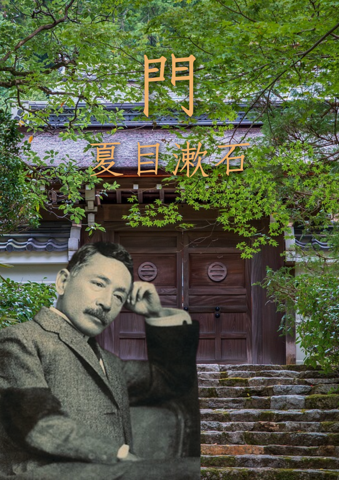
Background: Serialized in 1910, The Gate (Mon) is the conclusion of the trilogy following Sanshiro and And Then (Sorekara). The protagonists, Sosuke and his wife Oyone, live a quiet, ordinary, and slightly strained life, but their marriage hides a past of having hurt others. The novel does not focus on the moment of passion, but rather on how two people bear the consequences of their choices in daily life years later. They have each other, yet they maintain a distance from society, relatives, and the wider world.
Literary Features: Soseki writes slowly and precisely in The Gate. The veranda, the weather, the sounds of neighbors, the couple's conversations, physical fatigue, and financial pressure all become extensions of the characters' psychology. It’s not that Sosuke doesn't want to find liberation—he even attempts Zen meditation—but he remains outside "the gate," unable to truly enter. This imagery elevates the novel beyond a marriage story into a work about guilt, spiritual exhaustion, and the inability to save oneself. Its heaviness is not a sudden explosion, but a gradual accumulation day by day.
Story Introduction: The Gate is particularly suited for readers who have experienced major life choices or are enduring long-term psychological pressure. It tells us that life is not necessarily destroyed by dramatic events, but can be worn down by day-after-day silence after the events have ended. Many relationships appear stable, yet harbor an un-cleansable past within. This novel allows readers to see that true loneliness is sometimes not having no one by your side, but having someone there sharing the silence with you, yet no one can pass through that gate for you. Sosuke and Oyone's lives have no violent waves, yet they show traces of being weighed down by the past everywhere. Dependent on each other with deep affection, they keep their distance from relatives, society, and a broader life. The younger brother, the landlord, neighbors, and daily trifles constantly enter their lives, reminding Sosuke that reality does not stop because of inner pain. When he tries to find liberation through Zen, the novel offers no simple answers; he stands before the gate, knowing he wants to enter, yet still unable to take that step. Such a story can be entered without profound literary knowledge; by following the characters' choices, hesitations, and silences, one can feel the work slowly pushing a person's predicament before one's eyes.
Work Encyclopedia
Author's Life: In his later years, Natsume Soseki's novels continued to question loneliness, ethics, individualism, and self-fragmentation, pushing the modern Japanese novel toward more mature psychological depiction.
Relationship Between Author and Work: The Gate completes Soseki's trilogy, extending the decision in And Then into the daily punishment following that decision, and foreshadowing the deeper guilt and confession in Kokoro.
Modern Analogy: Like a couple living in a quiet apartment; stable on the outside, but inside there is always a room that cannot be opened, and which they dare not open."
Miva: the next reading experience beyond audiobooks
Listen like an audiobook, then ask anything, anytime.
Start Miva's narrationMiva does not just narrate. It keeps explaining based on what you ask.