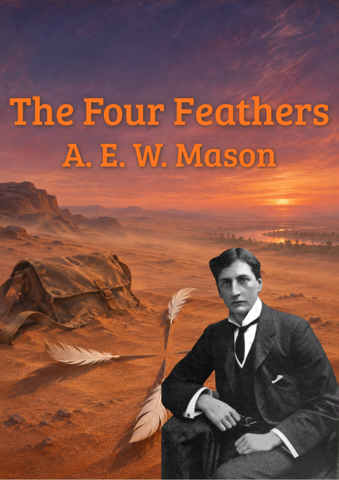
Background:
Published in 1902 and set against British military campaigns in Sudan, the novel links courage, shame, friendship, masculinity, and imperial ideology. Its adventure structure requires historical criticism of the colonial assumptions that organize the conflict.
The central tension:
After resigning his commission, Harry Feversham receives four white feathers as accusations of cowardice and undertakes a dangerous effort to answer those judgments. The guide avoids later outcomes while centering the social machinery of honor.
How the writing works:
Third-person adventure narration, delayed backstory, parallel acts of loyalty, geographic movement, tokens and letters, and repeated tests of witness turn reputation into something produced collectively.
Four white feathers reduce a complicated decision to a public verdict: coward. Mason then builds an adventure around the dangerous desire to answer that verdict in the language of the people who issued it. Harry Feversham's journeys are suspenseful, but the novel is equally concerned with who witnesses courage, who controls reputation, and whether an act has value if it remains unknown.
The Sudan setting cannot be treated as neutral scenery. The story draws its tests of British masculinity from imperial war and frequently subordinates Sudanese lives to the moral development of British characters. Reading critically does not erase the adventure; it clarifies the historical system that makes the adventure possible and exposes the limits of its sympathy.
The 1939 film is visually magnificent and helped fix the story in popular memory, yet it streamlines the novel's reconstruction of the feathers and reorganizes military events for spectacle. Readers interested in adaptation will gain most by comparing the different witnesses attached to each feather, not merely the scale of the battle scenes.
The feathers work because they turn uncertainty into an object that can be carried, hidden, returned, and witnessed. Harry's decision may have motives more complicated than fear, but his society recognizes only a public code of courage. His response is therefore shaped by the judgment he hopes to overturn: he enters danger anonymously and seeks acts that will become legible to the people who condemned him. Adventure and psychological compulsion move together.
That structure also exposes the novel's imperial limits. Sudan and its people are too often made the testing ground for British character, while military violence supplies opportunities for private redemption. A critical reading should not neutralize this history, but neither need it deny Mason's control of suspense, secrecy, and delayed recognition. The most revealing question is not simply whether Harry is brave. It is why courage must be certified by particular witnesses, and what remains unseen when an empire supplies the stage.
The adventure remains effective because each dangerous episode answers a private accusation as well as an external threat. Harry must act without claiming credit, while the people who judged him gradually confront the limits of what they saw. That structure turns the return of each feather into an emotional event. Readers can enjoy the concealment, pursuit, and reversals while also questioning the imperial code that supplies their meaning. The tension between narrative excitement and historical discomfort is not a reason to avoid the novel; it is the reason to read it attentively.
Director: Zoltán Korda
Production country: United Kingdom
Cast: John Clements, Ralph Richardson, June Duprez
Difference from the book: reworks the chronology and military setting for a large-scale imperial adventure while simplifying the novel's extended reconstruction of reputation.
The 31-chapter novel differs substantially from its films in chronology, military events, and character design; screen memories should not fill gaps in the text.
Repeated screen adaptation made the white feathers widely recognizable, but responsible reading must separate the novel's compelling honor plot from its imperial hierarchy and racialized representation of Sudan.
Miva: the next reading experience beyond audiobooks
Listen like an audiobook, then ask anything, anytime.
Start Miva's narrationMiva does not just narrate. It keeps explaining based on what you ask.