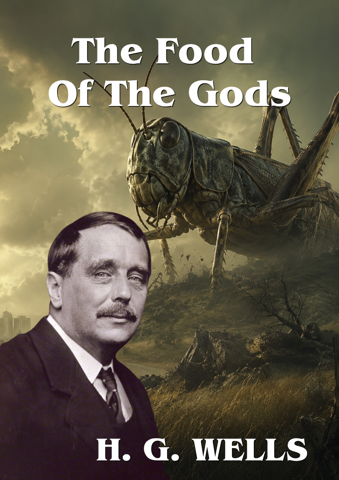
When Growth Becomes Monstrous・H. G. Wells's Terrifying Vision of Evolution Beyond Control
The Food of the Gods and How It Came to Earth (1904) stands as one of H. G. Wells's most unsettling and intellectually provocative scientific romances—a novel that transforms the simple notion of growth into a profound meditation on power, evolution, class conflict, and the future of humanity. Beneath its premise of giant children and monstrous vermin lies a deeply philosophical work asking a terrifying question: what happens when humanity creates something larger than itself—literally and metaphorically?
The Substance That Broke the World
The story begins with scientific ambition. Mr. Bensington and Professor Redwood, driven by biological curiosity, develop a growth-enhancing substance first grandly named "The Food of the Gods," later scientifically classified as Herakleophorbia IV. What begins as laboratory speculation soon spirals into societal upheaval. Chickens grow monstrous. Wasps become airborne horrors. Rats become predators of terrifying scale. But Wells's true concern lies not in giant animals—it lies in giant humans.
The children raised on the substance grow into colossal beings, towering over ordinary society. Wells turns this physical scale into metaphor: these giants are the embodiment of a new humanity—stronger, freer, more expansive, and fundamentally incompatible with the old world. Their existence becomes a threat not because of violence, but because they represent inevitable transformation. The "little people" fear them because giants expose the limitations of conventional society.
The novel's final act becomes a philosophical war. The conflict between ordinary humans and the giant children reflects a broader struggle between stagnation and growth—a tension the novel elevates beyond monster fiction into a manifesto about progress itself. The Food of the Gods remains strikingly relevant in the age of genetic engineering, artificial intelligence, and biotechnology. Wells understood that humanity's greatest fear is not monsters—it is transformation. The true terror lies in change so radical that the old world can no longer survive it.
Reaching Across Time into Modern Culture
Though not as universally celebrated as The Time Machine or The War of the Worlds, The Food of the Gods profoundly influenced science fiction's fascination with scale, mutation, and scientific hubris. Its DNA can be seen in later works involving giant creatures, altered biology, and civilization overwhelmed by its own inventions—from Attack of the 50 Foot Woman to Godzilla, and from mutation cinema to modern bioengineering fiction.
The novel inspired multiple film adaptations, though none fully captured Wells's philosophical depth. Bert I. Gordon's Village of the Giants (1965) transformed the premise into psychedelic teen science fiction. His later adaptation, The Food of the Gods (1976), leaned heavily into ecological horror with giant rats and monstrous creatures. Gnaw: Food of the Gods II (1989) pushed the concept further into cult B-movie territory. These adaptations emphasized spectacle, but Wells's original power lies in his ideas. His influence reaches far beyond cinema—science fiction as a genre repeatedly returned to his core theme of humanity losing control of the forces it creates, a tradition inherited by writers like Isaac Asimov, Arthur C. Clarke, and Ursula K. Le Guin.
Praised by the Great Minds of the World
"We fight not for ourselves but for growth, growth that goes on for ever."――Cossar's son, The Food of the Gods and How It Came to Earth
"The Shakespeare of science fiction."――Brian Aldiss
"O Realist of the Fantastic!"――Joseph Conrad
"The minds of all of us… would be perceptibly different if Wells had never existed."――George Orwell
Miva: the next reading experience beyond audiobooks
Listen like an audiobook, then ask anything, anytime.
Start Miva's narrationMiva does not just narrate. It keeps explaining based on what you ask.