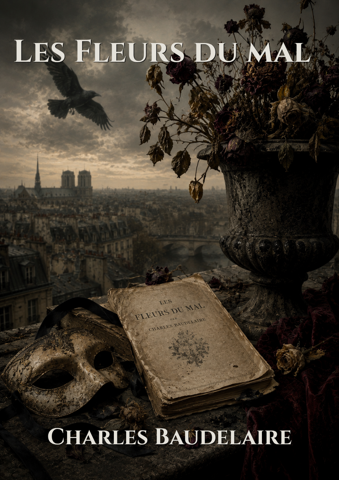
The Flowers of Evil (Les Fleurs du mal) is Charles Baudelaire's masterpiece and one of the most important collections in all of French literature. First published in 1857 and then profoundly revised in 1861, this book marks a decisive break in the history of modern poetry. Baudelaire develops a new vision of the world based on human contradictions, the beauty of evil, inner suffering, and the experience of urban modernity.
The title of the collection summarizes the author's poetic project: to transform evil, misery, vice, and pain into artistic beauty. Baudelaire seeks to extract "flowers" from what appears impure or condemnable. This ambition is summarized in his famous phrase: "You gave me your mud and I turned it into gold." Poetry thus becomes a means of transfiguring human reality, even in its darkest aspects.
The 1861 edition contains one hundred and twenty-six poems divided into six major sections that represent a kind of spiritual journey:
Spleen and Ideal
Parisian Scenes
Wine
Flowers of Evil
Revolt
Death
The first part, Spleen and Ideal, constitutes the heart of the collection. Baudelaire describes the inner struggle between two opposing forces: "spleen," a symbol of boredom, melancholy, and despair, and the "ideal," which represents dreams, beauty, love, and spiritual elevation. The poet appears as a deeply divided being, unable to find lasting happiness. This internal conflict gives the collection its tragic tone.
Several famous poems belong to this section. In "The Albatross," Baudelaire compares the poet to a large, majestic bird in the sky but clumsy and humiliated when on the deck of a ship among men. The poem illustrates the condition of the modern poet: superior through imagination, but misunderstood by society. In "Correspondences," Baudelaire develops an essential theory of symbolism: the visible world hides mysterious links between sounds, colors, perfumes, and sensations. The senses respond to one another and provide access to a deeper truth.
With Parisian Scenes, added in the 1861 edition, Baudelaire becomes one of the first great poets of the modern city. Paris is no longer simply a backdrop: the city becomes a true poetic subject. Baudelaire describes the streets, the crowds, the passersby, the poor, the elderly, and the marginalized. He shows the loneliness of man in the middle of the crowd and reveals the strange beauty of urban life. In poems like "To a Passerby," he expresses the fleeting beauty of an anonymous encounter in the modern city.
The theme of love also occupies a central place in the collection. Women often appear as mysterious, sensual, and sometimes dangerous figures. Jeanne Duval, Baudelaire's famous mistress nicknamed the "Black Venus," inspired several important poems such as "Exotic Perfume," "The Head of Hair," or "The Dancing Serpent." For Baudelaire, love is rarely peaceful: it is linked to desire, suffering, fascination, and sometimes destruction.
The collection also addresses subjects considered scandalous in the 19th century: eroticism, lesbianism, satanism, the decomposition of the body, intoxication, and artificial paradises. Baudelaire voluntarily explores forbidden areas of human experience to show the full complexity of the soul. This freedom caused an immense scandal when the book was published in 1857. The poet and his publisher were prosecuted for "outrage to public morality and good manners." Six poems were banned, and Baudelaire had to pay a fine. This conviction was not overturned until 1949.
Despite this scandal, The Flowers of Evil had an immense influence. Baudelaire profoundly renewed French poetry while often retaining classical forms like the sonnet and the alexandrine. However, he brought a new musicality, a language rich in symbols, and an exceptional emotional intensity. His use of synesthesia—the association of sensations with each other—became an essential characteristic of modern poetry.
The work directly influenced symbolist poets like Paul Verlaine, Arthur Rimbaud, and Stéphane Mallarmé, but also 20th-century literary movements, notably surrealism. Even today, The Flowers of Evil remains a fundamental work that continues to fascinate with its psychological depth, musical beauty, and modern vision of the human condition.
Miva: the next reading experience beyond audiobooks
Listen like an audiobook, then ask anything, anytime.
Start Miva's narrationMiva does not just narrate. It keeps explaining based on what you ask.