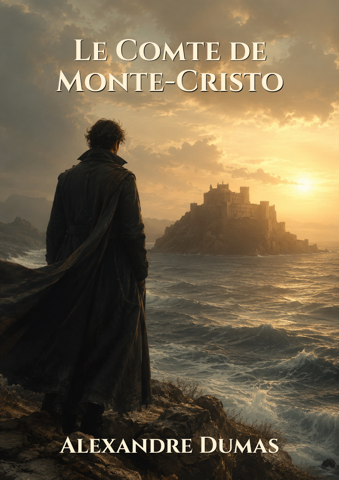
The Count of Monte Cristo is one of the most famous novels in French literature, written by Alexandre Dumas in collaboration with Auguste Maquet. Published as a serial between 1844 and 1846, the novel blends adventure, revenge, politics, love, and philosophical reflection. Today, it is considered one of the greatest adventure novels of the 19th century.
The story follows Edmond Dantès, an honest and promising young sailor leading a happy life in Marseille. On the verge of becoming a captain and marrying Mercédès, he falls victim to a plot orchestrated by men jealous of his success. Falsely accused of being a Bonapartist agent, he is arrested and imprisoned in the Château d'If without a fair trial.
During fourteen years of captivity, Dantès sinks into despair before meeting Abbé Faria, a scholarly prisoner who becomes his mentor and friend. Faria transmits immense knowledge to him—languages, history, philosophy, science—and reveals the existence of a hidden treasure on the island of Monte Cristo. After a spectacular escape, Edmond discovers the treasure and is reborn under a new identity: the mysterious and powerful Count of Monte Cristo.
Returning to Parisian society, he prepares a methodical revenge against those who betrayed him: Danglars, Fernand Mondego, Villefort, and Caderousse. However, throughout his journey, the novel moves beyond simple revenge to question justice, fate, human suffering, and the possibility of forgiveness.
The novel is distinguished by:
The work also addresses major themes:
The novel's final sentence, famous worldwide:
"Wait and hope."
summarizes the deep message of the work.
Since its publication, The Count of Monte Cristo has been translated into many languages and adapted into hundreds of films, series, plays, and television works. It remains today one of the most widely read French novels in the world.
Le Comte de Monte-Cristo follows the tragic yet triumphant journey of Edmond Dantès, a young, promising French sailor who is falsely accused of treason on the eve of his wedding to the beautiful Mercédès. Betrayed by men he trusted, the jealous officer Fernand Mondego, the envious clerk Danglars, and the self-serving magistrate Gérard de Villefort, Dantès is arrested and thrown into the grim dungeons of the Château d'If without a trial. For fourteen years, Dantès endures solitary confinement and deep despair. His life changes forever when he meets Abbé Faria, a brilliant Italian priest imprisoned in a neighboring cell. Faria becomes Dantès’s mentor, educating him in philosophy, languages, history, and science. Before his death, Faria discloses the location of a vast hidden treasure on the desolate island of Monte Cristo. Following Faria's death, Dantès brilliantly executes a perilous escape by concealing himself inside his dead friend's body bag and being thrown into the sea. After swimming to safety and securing the secret fortune, Dantès undergoes a complete reinvention. He adopts the persona of the mysterious and immensely wealthy Count of Monte Cristo. Guided by a belief that he is an instrument of divine justice, he systematically infiltrates the high society of Paris, where his betrayers have all risen to positions of immense power and wealth. One by one, the Count orchestrates the downfall of his enemies by exploiting their secret vices and past crimes. He orchestrates the financial ruination and social disgrace of Danglars, driving the banker into bankruptcy. He reveals how Fernand Mondego betrayed his benefactor, Ali Pasha, which destroys Fernand's reputation, prompts Mercédès and their son Albert to abandon him, and leads Fernand to commit suicide. Against Villefort, the prosecutor who condemned him, Monte Cristo uncovers dark family secrets and poisonings that culminate in the death of Villefort’s young son and Villefort’s descent into madness. Meanwhile, Monte Cristo secretly protects those who remained loyal, including the family of his former employer, Morrel, and Morrel's son Maximilien. However, as his vengeance unfolds, Monte Cristo witnesses the severe collateral damage inflicted upon innocent lives, particularly the death of young Édouard de Villefort. Overwhelmed by remorse and recognizing the limits of human vengeance, he halts his wrath and seeks spiritual redemption. He intervenes to save Maximilien Morrel from despair by fake-poisoning and preserving the life of Maximilien’s beloved, Valentine de Villefort, ultimately reuniting the young lovers on the island of Monte Cristo. In the end, having bestowed his vast wealth upon Maximilien, Valentine, and Haydée, the Ottoman princess who wins his heart, the Count bids farewell to his past. He sets sail into the horizon with Haydée, leaving behind a simple yet profound testament for humanity: that all human wisdom is contained in two words, wait and hope.
Edmond, ever since I have known you, I have cherished your name and revered your memory. Edmond, my friend, do not force me to tarnish this noble and pure image that is endlessly reflected in the mirror of my heart. Edmond, if you only knew all the prayers I offered to God on your behalf, both while I hoped you were still alive and after I believed you dead, yes, dead, alasOriginal: Edmond, depuis que je vous connais j’ai adoré votre nom, j’ai respecté votre mémoire. Edmond, mon ami, ne me forcez pas de ternir cette image noble et pure reflétée sans cesse dans le miroir de mon cœur. Edmond, si vous saviez toutes les prières que j’ai adressées pour vous à Dieu, tant que je vous ai espéré vivant et depuis que je vous ai cru mort, oui, mort, hélasThe Count of Monte Cristo Chapter on Mercédès and Edmond's reunion. It highlights the tragedy of lost love and the emotional conflict between Dantès's unrelenting pursuit of vengeance and Mercédès's enduring, sacred affection for him.
In application, no; in principles, yes: learning is not knowing; there are those who have knowledge and those who are truly wise: memory makes the former, philosophy makes the latter.Original: Dans leur application, non; dans leurs principes, oui: apprendre n’est pas savoir; il y a les sachants et les savants: c’est la mémoire qui fait les uns, c’est la philosophie qui fait les autres.The Count of Monte Cristo Château d'If Imprisonment. This passage establishes the intellectual transformation of Dantès, shifting him from an uneducated sailor into a deeply philosophical strategist capable of carrying out his grand design.
As for you, Morrel, here is the whole secret of my conduct toward you: there is neither happiness nor misery in this world, there is only the comparison of one state to another, that is all. He alone who has felt the deepest despair is capable of experiencing supreme bliss. One must have wished to die, Maximilien, to know how good it is to live.Original: Quant à vous, Morrel, voici tout le secret de ma conduite envers vous: il n’y a ni bonheur ni malheur en ce monde, il y a la comparaison d’un état à un autre, voilà tout. Celui-là seul qui a éprouvé l’extrême infortune est apte à ressentir l’extrême félicité. Il faut avoir voulu mourir, Maximilien, pour savoir combien il est bon de vivre.The Count of Monte Cristo The Count's Final Letter to Maximilien. It articulates the core thematic takeaway of the entire novel regarding human suffering, perspective, and the true measure of joy.
Live, then, and be happy, beloved children of my heart, and never forget that, until the day God deigns to reveal the future to man, all human wisdom is contained in these two words: "Wait and hope!Original: Vivez donc et soyez heureux, enfants chéris de mon cœur, et n’oubliez jamais que, jusqu’au jour où Dieu daignera dévoiler l’avenir à l’homme, toute la sagesse humaine sera dans ces deux mots: « Attendre et espérer! »The Count of Monte Cristo The Final Chapter. It delivers the ultimate moral message of the narrative, emphasizing divine providence, patience, and hope after a saga dominated by retribution.
While the novel is a massive nineteenth century work, its original serial format makes it surprisingly accessible and engaging. Alexandre Dumas wrote the story in episodic installments, filling the narrative with sharp dialogue, dramatic cliffhangers, and fast pacing. Readers navigating the text for the first time will find that the primary challenge is keeping track of the large cast of characters and their interconnected subplots across French high society. Once the main setup in the Château d'If is established, the momentum of the plot carries the reader smoothly through its multi-layered storylines.
The work is celebrated globally because it sets the standard for epic revenge stories and historical adventure narrative technique. Alexandre Dumas weaves together elements of political intrigue, psychological drama, and philosophical reflection on human suffering. The emotional core of the novel rests on the transformation of an innocent young man into an all-powerful figure of retribution, a premise that has influenced storytellers for generations. Its enduring popularity stems from its memorable characters and its timeless exploration of whether absolute justice can ever be achieved by human hands.
The final chapters bring the long, complex web of revenge to a quiet resolution where long-standing debts are settled and true intentions revealed. What makes the conclusion so memorable is how the tone shifts from calculated wrath to spiritual reflection, opening up an unexpected space for grace and restoration. The ultimate payoff lies in how the remaining characters choose to rebuild their lives after the storm clears, leaving readers with a profound lesson on faith, patience, and human destiny.
At the story's horizon lies the ultimate culmination of a long, agonizing patience, a moment where the full weight of suffering, faith, and human justice is finally brought to light. What waits at the end is not merely the final reckoning of debts long overdue, but a profound transformation of spirit. As the storm of vengeance clears, it reveals a quiet sanctuary where broken lives are mendable, where darkness gives way to an unexpected grace, and where the deepest wounds of despair are met with a transcendent mercy. It is a destination where all human wisdom ultimately converges into a timeless truth, waiting to be discovered by those who endure the journey.
The novel was written by Alexandre Dumas in collaboration with Auguste Maquet. Published as a serial between 1844 and 1846, it quickly became one of the author's most famous literary achievements alongside his other major historical adventures.
The central message of the work is captured in its world-famous closing sentence, which encapsulates the values of patience, faith, and divine justice. Through Dantès's arc, the novel shows that human beings cannot control the future and must learn to endure trials until destiny unfolds.
Miva: the next reading experience beyond audiobooks
Listen like an audiobook, then ask anything, anytime.
Start Miva's narrationMiva does not just narrate. It keeps explaining based on what you ask.