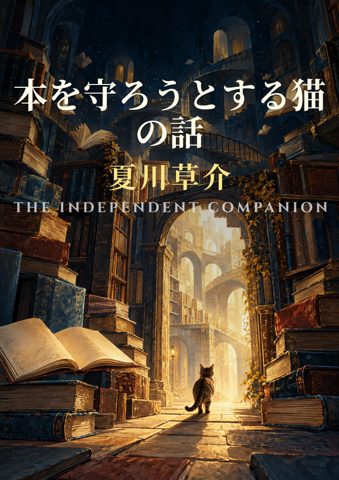
'The Cat Who Saved Books' is a novel by Sosuke Natsukawa that draws readers into a story starting from the moment the shape of daily life is shaken. A boy who inherits his grandfather's secondhand bookstore is led by a talking cat into labyrinths where books are imprisoned, chopped up, and treated merely as symbols of authority.
This book is an independently produced chapter-by-chapter guide and summary that organizes the logic of those who handle books in each labyrinth, Rintaro's responses, and the cat's questions. It is not the original text; it does not reveal the resolution of the final labyrinth or the boy's ultimate choice.
An international sensation with translations and publications confirmed in over 20 countries.
Collecting books, fragmenting them for speed-reading, and measuring value solely by sales can all be explained as being "for the sake of books." Through the dialogues in the labyrinths, the work asks whether protecting books means preserving objects or returning words to human experience and action.
For each labyrinth, the guide maps the arguments of the Imprisoner, the Chopper, and the Seller against Rintaro's rebuttals. It distinguishes between the words inherited from his grandfather and the words Rintaro chooses for himself, allowing readers to track the progression of the adventure and the changes in his heart simultaneously. The solution to the final labyrinth is withheld.
By comparing the logic of each labyrinth—imprisoning, summarizing, and measuring by sales—the guide illustrates a structure showing that "protecting" is more than just preservation.
Follow the shift from Rintaro borrowing his grandfather's words to the stage where he argues with his own words, through his dialogues and choices with the cat.
The guide connects scenes depicting reading as an act of approaching the pain of others, organizing how the story demands not just praise for book lovers, but responsibility for their actions.
Suitable for adults and young readers interested in bookstore fantasy, a boy's coming-of-age, and reading ethics. It can be used for dialogues between parents and children or in schools, though it leaves the conflict between different views of reading intact rather than reducing the work to a simple slogan like "reading is good."
About this Edition: This product is an independently produced chapter guide and summary, not the original text. It is recommended for use alongside the full original work for review and reading support.
Miva: the next reading experience beyond audiobooks
Listen like an audiobook, then ask anything, anytime.
Start Miva's narrationMiva does not just narrate. It keeps explaining based on what you ask.