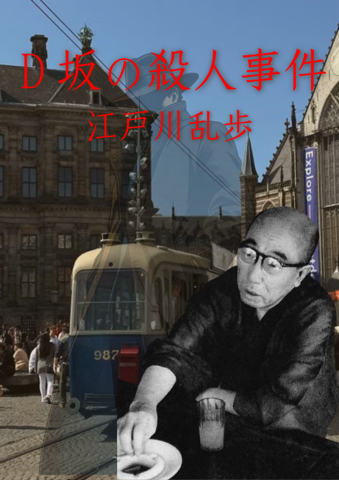
Background: The debut of Kogoro Akechi. The dialogue between the observer "I" and Akechi, the arrangement of eyewitness testimony, and an interest in abnormal psychology are structured in two parts: Facts and Reasoning. Considering the era of its creation and the history of its publication helps clarify what the narrative and expressions were responding to. Alternative titles found by readers in searches should be treated as supplementary information, while the standard title used in the included text is maintained consistently throughout.
Story and Content: The proprietress of a secondhand bookstore on D. Hill is found dead, and "I" and Kogoro Akechi, who were at a cafe across the street, examine the scene and testimonies. The locked-room-like situation shifts into a question of how to interpret what should have been visible. This provides an entry point for reading the development and form of the text, rather than just details of the ending or a character list. The gap between what the narrator knows and what the reader can infer, as well as shifts in time due to the sequence of chapters or songs, also serve as clues for interpretation.
Literary Features: The two-part structure of "Facts" and "Reasoning" flips the meaning of the same scenery. By layering the perspective from the cafe, the shop's layout, and the time lag between testimonies, it demonstrates that seeing and understanding are not the same. By verifying the tone, pauses, and repetitions that disappear in a simple summary, the unique flavor of the work becomes clearer.
Encyclopedia
Author Biography: Edogawa Ranpo (1894–1965) was a leading Japanese detective fiction writer, critic, and editor, born Taro Hirai. He used a pen name based on Edgar Allan Poe and depicted codes, locked rooms, disguises, perverse psychology, and the spectacle of the city in diverse forms. In his early short stories, he introduced Kogoro Akechi, linking criminal psychology with logical reasoning. He later developed a series for children centered on the Boy Detectives Club and the Fiend with Twenty Faces, and after the war, he devoted himself to the activities of the Detective Writers Club of Japan and nurturing new talent.
Relationship Between Author and Work: A short story where early Ranpo experimented with psychology, eyewitness testimony, and logical reconstruction, it is also the first appearance of Kogoro Akechi. One can observe a younger and more ambiguous characterization than his later image as a famous detective.
Video Comparison (Recent Decade): While NHK's "Series Edogawa Ranpo Short Stories IV: New! Boy Detectives Club" (2021) is not a direct adaptation of this work, it translates Ranpo's narrative and visual gimmicks into modern short-form video. In contrast to the psychological reasoning of this work, the program emphasizes boyish adventure and theatricality. By clearly stating the title and year, and treating non-direct adaptations as thematic comparisons, we compare the differences in focus according to media and era.
Publisher
BookAI
Published
2026-09-16
Miva: the next reading experience beyond audiobooks
Listen like an audiobook, then ask anything, anytime.