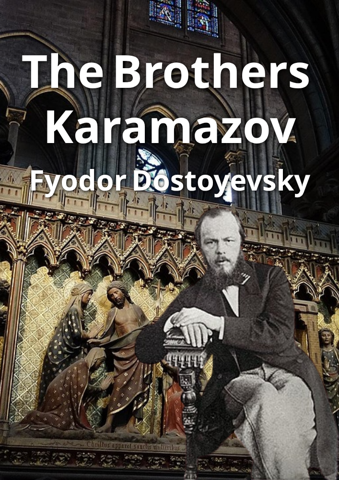
"The Brothers Karamazov" centers on a case of parricide, placing faith, free will, guilt, desire, and familial hatred on trial. The three brothers represent three directions of the soul—sensuality, rational doubt, and religious compassion—pulling against each other and turning the novel into a massive theater exploring whether humanity can endure freedom.
Fyodor Dostoyevsky was once sentenced to death for political crimes, pardoned just before execution, and later exiled to Siberia; his life was plagued by debt, epilepsy, spiritual crises, and Russian ideological debates. "The Brothers Karamazov" is the culmination of his late years, compressing nearly all of his life experiences: crime is not merely a legal event, but a rupture of the soul, thought, and love.
It can be read alongside Marilynne Robinson’s novels of religious ethics, Cormac McCarthy’s inquiries into evil, or Donna Tartt’s "The Secret History" for its sense of guilt and complicity. If one wishes to understand existential anxiety before the advent of existentialism, this book is the essential gateway.
The volume-by-volume breakdown of the plot reveals that this is not a simple crime novel, but a spiritual trial unfolding layer by layer: the depravity and absurdity of the father Fyodor, Dmitri’s passion and debts, Ivan’s rational rebellion, Alyosha’s practice of faith, and Smerdyakov’s resentment and imitation together turn the question of "who is guilty" into one that is difficult to answer. The law can identify a murderer, but Dostoyevsky is more concerned with: Can thoughts commit crimes? Can indifference participate in murder? Does the corruption of a family make everyone a complicit party?
The "Grand Inquisitor" chapter has been discussed for so long precisely because it pushes the conflict between freedom and happiness to its extreme: Do people truly want freedom, or do they prefer to surrender it in exchange for bread, miracles, and authority? Following his exile, the shadow of death, and his return to religion, Dostoyevsky offered no easy answers. Thus, "The Brothers Karamazov" is a family saga, a philosophical drama, a courtroom thriller, and a summation of a crisis of faith.
In this curation, it represents the pinnacle of the "underground" spirit: man suffers not from a lack of thought, but because thought is so powerful it may even turn against life itself. Contemporary readers can connect it to family trauma in psychotherapy, ideological responsibility in political polarization, and the recurring explorations of sin, complicity, and redemption in modern fiction. It is vast, but its core question is direct: If God is silent, the father is corrupt, and love is mixed with possession, how can one still choose the good?
The dark and tempestuous world of the Karamazov family unfolds in the Russian town of Skvoreshniki, driven by deep spiritual, moral, and psychological conflicts. At the center stands Fyodor Pavlovitch Karamazov, a depraved and greedy landowner, and his three sons: Dmitri (Mitya), a passionate and impulsive army officer; Ivan, a brilliant yet tormented intellectual struggling with faith and nihilism; and Alyosha, a gentle, compassionate novice at the local monastery. A fourth, unacknowledged son, Smerdyakov, serves as Fyodor’s quiet, cunning valet. Tensions peak over money and the love of Grushenka, a fiercely independent woman sought by both Fyodor and Mitya. Consumed by jealousy and desperate for cash, Mitya publicly threatens his father’s life. Meanwhile, Ivan formulates the radical philosophical premise that if God does not exist, "everything is lawful", an idea that deeply impresses Smerdyakov. The crisis culminates in Fyodor’s murder. That night, Mitya enters his father's garden armed with a brass pestle, intent on finding Grushenka. Though overcome by a sudden moral impulse and fleeing without harming his father, Mitya strikes the servant Grigory during his escape. He then squanders stolen cash on an extravagant spree with Grushenka, leading to his swift arrest. The legal authorities discover three thousand roubles missing from Fyodor’s room and assume Mitya killed his father for the inheritance. Despite Mitya’s claims of innocence during intense interrogations, circumstantial evidence heavily weighs against him. As the trial approaches, Ivan discovers the terrifying truth. In a series of harrowing meetings, Smerdyakov confesses to Ivan that he murdered Fyodor himself, luring the old man to the window using secret signals. Smerdyakov reveals the stolen money and asserts that Ivan is the true instigator, having sanctioned the crime through his nihilistic teachings. Overwhelmed by moral complicity and descending into mental illness and feverish hallucinations, Ivan resolves to confess in court. However, Smerdyakov commits suicide shortly before he can be called to testify. At the trial, Ivan attempts to confess and present the recovered money, but his testimony devolves into a delirious, chaotic outburst. In a desperate attempt to save Ivan's reputation, Katerina Ivanovna, Mitya’s former fiancée, produces a letter Mitya wrote prior to the crime detailing a desire to kill his father. This sudden revelation destroys Mitya’s defense. Despite an eloquent plea from his lawyer, the local peasant jury stands firm and delivers a guilty verdict, sentencing Mitya to twenty years of hard labor in Siberia. Following the trial, Mitya makes peace with his fate, planning a eventual escape to America with Grushenka, supported by Alyosha, who recognizes his brother's spiritual innocence. The narrative transitions from the courtroom tragedy to the tender funeral of young Ilusha Snegiryov, a local boy who died of illness. Gathering Ilusha’s young schoolfellows around a large stone, Alyosha delivers a passionate speech, urging the boys to preserve pure childhood memories as a lifelong moral anchor against evil. He affirms his belief in love, resurrection, and eternal life, leading the boys in a unified vow to remember Ilusha and remain good, kind, and brave.
Even there, in the mines, under-ground, I may find a human heart in another convict and murderer by my side, and I may make friends with him, for even there one may live and love and suffer. One may thaw and revive a frozen heart in that convict, one may wait upon him for years, and at last bring up from the dark depths a lofty soul, a feeling, suffering creature; one may bring forth an angel, create a hero!The Brothers Karamazov Book XI, Chapter 4. It expresses the novel's profound theme of redemption through suffering and the capacity to find divine grace and humanity in the lowest places.
Though I may not believe in the order of the universe, yet I love the sticky little leaves as they open in spring. I love the blue sky, I love some people, whom one loves you know sometimes without knowing why.The Brothers Karamazov Book V, Chapter 3. It reveals the vital Karamazov tension between analytical nihilism and an overwhelming, visceral devotion to life itself.
It’s not God that I don’t accept, Alyosha, only I most respectfully return Him the ticket.The Brothers Karamazov Book V, Chapter 4. It stands as one of literature's most articulate and heartbreaking formulations of the problem of evil and philosophical rebellion.
Readers often wonder if this classic presents insurmountable difficulties due to its monumental length and dense philosophical content. While the novel covers deep theological and psychological terrain, its core narrative moves with the speed and tension of a psychological thriller. The primary challenge lies in navigating Victorian prose conventions, nineteenth century Russian naming systems, and extended philosophical monologues such as the famous Grand Inquisitor sequence. However, Dostoyevsky Grounds these abstract discussions in intense emotional conflicts and high stakes personal drama. Characters speak with passionate clarity about foundational human experiences like love, jealousy, betrayal, and faith. Once a reader becomes accustomed to the cadence of the translation and the distinct voices of the three brothers, the story unfolds with remarkable narrative momentum. The novel rewards patience by offering deeply relatable character arcs and dramatic court confrontations that remain vivid long after the book is finished.
The work maintains its status as a supreme masterpiece because it synthesizes dramatic storytelling with profound philosophical inquiry. Dostoyevsky creates characters who represent distinct worldviews yet remain fully realized, complex human beings rather than mere allegorical mouthpieces. The novel anticipates major twentieth century movements in psychology and existential philosophy by exploring the subconscious mind, moral freedom, and the consequences of nihilism. Its examination of structural family trauma, social polarization, and the search for meaning in a secularizing world continues to resonate across cultures. Furthermore, the prose achieves an extraordinary polyphonic quality where conflicting moral perspectives are voiced with equal power and dignity. By forcing readers to confront the most difficult questions about evil, justice, and spiritual redemption through a compelling murder mystery, the novel remains an essential exploration of the human condition.
What lies at the end of this monumental work is not a mere resolution of a murder trial, but a terrifying confrontation with the human soul. Beyond the courtroom walls waits a searing reckoning where intellectual pride collapses under the weight of moral responsibility, and where secret complicity demands its ultimate price. The narrative moves past legal justice to examine whether a fractured soul can endure the burden of freedom and seek true spiritual redemption amidst overwhelming tragedy. In its quietest, most poignant moments, a fragile beacon of hope emerges from the darkness of corruption and death, transforming grief into an enduring promise of love and resurrection. Read these closing pages for yourself.
The Grand Inquisitor chapter stands as one of the most celebrated passages in world literature. Embedded within a conversation between Ivan and Alyosha, the parable features a cardinal in sixteenth century Spain who arrests a returned Christ, arguing that true freedom is a burden most humans cannot bear. The Inquisitor claims that authority, miracle, and mystery are necessary to keep humanity happy and controlled. This dramatic confrontation embodies the novel's core debate between rational totalitarian order and radical spiritual freedom. By presenting the argument against freedom with such formidable power, Dostoyevsky challenges readers to evaluate what human beings truly require to live meaningful lives.
The novel represents the culmination of Dostoyevsky's lifetime of personal struggle, ideological transformation, and literary craft. Having survived a mock execution, years of Siberian exile, severe epilepsy, and profound personal grief, Dostoyevsky poured his ultimate reflections on suffering and faith into this final text. His deep familiarity with Russian legal reforms, revolutionary political ideas, and monastic traditions directly shapes the novel's realistic setting and authentic debates. The character of Alyosha was named in memory of Dostoyevsky's young son who died shortly before the author began writing, adding intense personal gravity to the novel's spiritual themes regarding childhood, innocence, and grief.
While all three main brothers represent distinct facets of the author's complex psyche, Alyosha embodies Dostoyevsky's vision for spiritual restoration. Dmitri represents physical passion and chaotic honor, while Ivan embodies cold intellect and secular doubt. Alyosha, guided by the teachings of Father Zosima, practices an active compassion that enters directly into the suffering of the world rather than retreating from it. However, Dostoyevsky does not present Alyosha as a flawless saint; he carries the same turbulent Karamazov blood as his brothers, making his deliberate choice of active love and faith all the more significant and compelling.
Miva: the next reading experience beyond audiobooks
Listen like an audiobook, then ask anything, anytime.
Start Miva's narrationMiva does not just narrate. It keeps explaining based on what you ask.