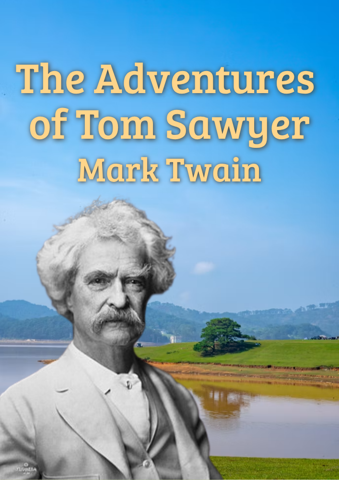
Story:
Tom Sawyer would rather trade treasures, stage battles, court Becky Thatcher, or slip away to the river than obey Aunt Polly. His games seem to transform punishment into triumph—until he and Huck Finn witness a crime in the graveyard and discover that make-believe courage is not the same as speaking when real danger waits. Childhood freedom, fear, vanity, and loyalty collide along the Mississippi.
Reading Highlights:
Twain builds the novel from unforgettable episodes: the whitewashed fence, pirate life on Jackson's Island, the courtroom, and the cave. Beneath the comic performance lies a sharp eye for adult superstition and social respectability. The book catches the unstable border where a child's adventure can suddenly become morally serious.
Directed by Don Taylor; United States; starring Johnny Whitaker, Celeste Holm, Warren Oates, Jodie Foster, and Jeff East. The family musical received Academy Award nominations at the 1974 ceremony, including for its adapted score and original song score.
How it differs from the book:
The film adds songs and reshapes Twain's chain of episodes into a shorter family-film arc, reducing some satirical digressions and secondary adventures.
How to choose a reader's edition:
Choose the complete 35-chapter novel, not a picture-book retelling or a combined Tom Sawyer/Huckleberry Finn adaptation. Notes are helpful for dialect, minstrel-era references, and the historical portrayal of race. Translators vary in how they render children's speech; the best preserve humor and social difference without making every voice sound alike.
Mark Twain published The Adventures of Tom Sawyer in 1876, drawing on remembered Missouri childhood while openly reshaping people and incidents into fiction. The book precedes Adventures of Huckleberry Finn and introduces the river-town world that Twain would revisit with greater darkness. Here his gift for oral storytelling and comic performance already works beside a critical eye for schooling, religion, punishment, and adult respectability.
Set in the 1840s in the quiet town of St. Petersburg, Missouri, The Adventures of Tom Sawyer follows a imaginative, mischievous boy raised by his Aunt Polly alongside his half-brother Sid and cousin Mary. Tom constantly avoids chores, plays hooky from school, and engages in theatrical games of pretend with his friends. After falling in love with Becky Thatcher, the judge's daughter, Tom experiences a dramatic romantic falling-out that sets a tone of restless longing for real adventure. Late one night, Tom and his outcast friend Huckleberry Finn sneak into the local graveyard with a dead cat, hoping to test a superstitious cure for warts. Instead, they witness a gruesome murder. Injun Joe, a dangerous local outcast, kills Dr. Robinson during a dispute over grave-robbing and frames the harmless town drunkard, Muff Potter. Terrorized by fear of Injun Joe's revenge, Tom and Huck swear a solemn blood oath never to reveal what they saw. Guilt and anxiety weigh heavily on Tom. To escape his troubles, he convinces Joe Harper and Huck Finn to run away to Jackson’s Island in the Mississippi River to live as pirates. While the boys revel in their newfound freedom, the town believes they have drowned. Tom sneaks back to St. Petersburg one night and discovers Aunt Polly and the town mourning them. Moved, he plans a dramatic return: the boys march into their own funeral service at church, astonishing and delighting the congregation. Upon returning to school, Tom wins back Becky Thatcher's affections by gallantly taking the blame, and a severe whipping, for a book she accidentally tore. However, as Muff Potter's murder trial approaches, Tom's conscience overpowers his terror. Taking the witness stand, Tom courageously testifies to the truth, clearing Potter's name. Before Injun Joe can be apprehended, the murderer leaps through a courtroom window and escapes into the wild. Summer arrives, and Tom and Huck go hunting for buried treasure in a deserted, haunted house. While hiding upstairs, they witness Injun Joe and a companion enter and discover a hidden chest filled with thousands of dollars in gold coins. The criminals plan to hide the treasure elsewhere and seek revenge on someone in town. Huck secretly stalks Injun Joe to the Widow Douglas’s estate, overhearing Injun Joe's plan to mutilate her. Huck alerts a neighbor, saving the widow's life, though Injun Joe escapes once again. Meanwhile, Tom and Becky get lost inside the sprawling, labyrinthine depths of McDougal’s Cave during a picnic excursion. As the search parties lose hope, Tom and Becky spend days wandering in pitch darkness, weakened by hunger and exhaustion. At one point, Tom catches a terrifying glimpse of Injun Joe hiding in the cave, but manages to avoid detection. Demonstrating remarkable resilience, Tom eventually locates a tiny speck of daylight through a small opening, guiding Becky out to safety. Following their escape, Judge Thatcher orders the entrance of McDougal’s Cave sealed with iron doors. When Tom learns of this, he informs the judge that Injun Joe is inside. A party rushes to the cave and opens the doors, discovering that Injun Joe has starved to death just behind the iron threshold. After Injun Joe's funeral, Tom leads Huck back into the cave through the secret opening he found, where they recover the buried chest of gold. The boys become wealthy local heroes, and the funds are placed in a trust for them. The Widow Douglas officially adopts Huck Finn to civilize him. Though Huck detests the clean clothes, manners, and structure of respectable life and runs away, Tom convinces him to return by promising that they will form a band of robbers, maintaining their lifelong bond of wild youth.
In a word, everything that goes to make life precious that boy had. So thought every harassed, hampered, respectable boy in St. Petersburg.The Adventures of Tom Sawyer Chapter VI. It succinctly captures the romanticized allure of Huck Finn's absolute freedom, contrasting the innocence of unconstrained childhood with the rigid demands of adult society.
Every time I let him off, my conscience does hurt me so, and every time I hit him my old heart most breaks.The Adventures of Tom Sawyer Chapter I. This candid monologue highlights the tender emotional core of Aunt Polly, exposing the painful conflict between her perceived moral duty to punish Tom and her unconditional love for him.
Injun Joe lay stretched upon the ground, dead, with his face close to the crack of the door, as if his longing eyes had been fixed, to the latest moment, upon the light and the cheer of the free world outside.The Adventures of Tom Sawyer Chapter XXXIII. The striking visual imagery transforms a villain's demise into a poignant moment of tragedy, evoking pity for a dying man's desperate yearning for freedom.
The book is generally accessible, but modern readers may encounter minor hurdles due to 19th-century regional dialect, archaic vocabulary, and idiomatic speech. Mark Twain crafted the dialogue to reflect the authentic oral cadence of the 1840s Missouri river country. While the narrative prose remains clear, humorous, and fast-paced, the spoken dialogue includes localized slang, historical references, and non-standard grammar that require a brief period of adjustment. Once you tune into the rhythmic, performative quality of Twain's voice, the story flows easily. Edition notes can provide helpful context regarding historical terms and cultural references without interrupting the fun of the core adventure.
Mark Twain's novel redefined American literature by taking children's lives seriously while capturing the authentic vernacular of the American frontier. Before this book, stories for young people were heavily didactic, designed primarily to teach moral lessons about obedience and piety. Twain broke from this tradition by presenting a realistic, flawed, and deeply human protagonist who prefers play to school, yet possesses an inner moral compass. The novel serves as both a nostalgic celebration of uninhibited youth and a sharp satire of adult respectability, religious hypocrisy, and small-town superstition, establishing a distinctly American style of humorous storytelling.
At the end of the narrative, the bright, innocent world of childhood games collides head-on with the cold realities of mortality and justice. What awaits at the conclusion is not merely the resolution of a treasure hunt, but the ultimate test of survival inside the suffocating, pitch-black silence of McDougal’s Cave. The final chapters bring a reckoning for the villainous Injun Joe, forcing the reader to confront a haunting moment of human tragedy that lies frozen behind locked iron doors. Beyond the darkness, the story delivers the quiet heartbreak of growing up, as the spirit of absolute boyhood freedom faces the relentless, gentle trap of civilization.
The fence scene occurs in Chapter II, where Aunt Polly punishes Tom by making him whitewash a thirty-yard board fence on a sunny Saturday morning. Instead of laboring alone while other boys go swimming, Tom pretends that whitewashing is a rare, delicate art requiring immense skill. By making the task seem exclusive and desirable, he tricks his playmates into giving him their prized possessions, including a kite, a dead cat, and a brass doorknob, just for the privilege of painting a few feet of the fence, proving Twain's law of human action.
Huckleberry Finn is introduced as the son of the village drunkard, living completely outside the boundaries of adult supervision, school, and church. Because he wears discarded adult clothes and sleeps in empty hogsheads, the town mothers view him as an idle outcast, while all the local boys envy his absolute liberty. Huck serves as Tom's ultimate partner in nocturnal escapades, participating in the graveyard outing and the island pirate expedition. His outsider status provides the story with its sharpest contrast between natural freedom and civilized restraint.
Yes, it remains a staple of youth literature, though adult guidance is recommended to navigate historical context. The novel features classic themes of bravery, friendship, and imaginative play that continue to captivate younger audiences. However, because it was published in 1876 and set in the antebellum South, the text contains period-typical racial slurs, outdated stereotypes, and depictions of 19th-century disciplinary practices. Modern editions often include historical essays that help readers analyze these elements critically while enjoying the core narrative.
Miva: the next reading experience beyond audiobooks
Listen like an audiobook, then ask anything, anytime.
Start Miva's narrationMiva does not just narrate. It keeps explaining based on what you ask.