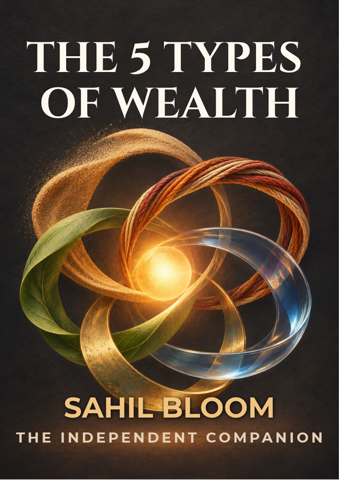
The 5 Types of Wealth by Sahil Bloom begins with a practical problem: A life can look financially successful while running deficits in time, relationships, health, or purpose. Sahil Bloom proposes measuring wealth across five interacting accounts.
This independent chapter guide organizes Time, Social, Mental, Physical, and Financial Wealth, then links the book's audits and experiments to tradeoffs rather than treating balance as a permanent equal split. It is an independent summary and reading companion, not the original book, and it helps readers connect the chapter sequence to decisions they can examine in their own lives.
Instant New York Times bestseller; USA Today bestseller; Sunday Times bestseller.
A life can look financially successful while running deficits in time, relationships, health, or purpose. Sahil Bloom proposes measuring wealth across five interacting accounts. The book approaches that question through examples, models, and behavioral observations rather than a guaranteed formula. This guide identifies where the author reports evidence, offers an interpretation, or recommends an action, so readers can evaluate each layer on its own terms.
This independent chapter guide organizes Time, Social, Mental, Physical, and Financial Wealth, then links the book's audits and experiments to tradeoffs rather than treating balance as a permanent equal split. Chapter notes preserve qualifications, counterexamples, and changes in scale that can disappear in a short list of tips. They also distinguish a memorable illustration from a universal rule and flag where taxes, regulation, income stability, health, or family responsibilities may change the result.
The guide tracks attention, energy, autonomy, and the calendar evidence behind stated priorities.
Relationships compound through presence, repair, and repeated small contact.
A financial decision can purchase time or damage health; the guide makes cross-effects explicit.
Readers working through The 5 Types of Wealth can use this companion to navigate its self-development, life design, time, relationships, health, money arguments, prepare a book-club discussion, compare its framework with another method, or return later to locate a specific claim. It favors clear navigation over hype and does not promise wealth, retirement, happiness, or therapeutic change. Financial and psychological examples are educational; important decisions should be adapted to personal circumstances and, when appropriate, reviewed with qualified professionals.
Edition notice: This is an independent chapter guide and summary, not the original book. It is designed for review and reading support and is best used alongside the full work.
Miva: the next reading experience beyond audiobooks
Listen like an audiobook, then ask anything, anytime.
Start Miva's narrationMiva does not just narrate. It keeps explaining based on what you ask.