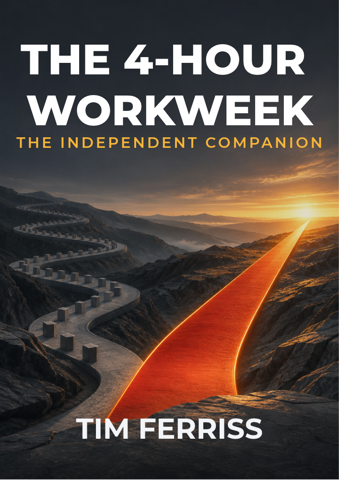
What if the real goal isn't retirement at the end of a career, but gaining more control over time while health and curiosity are still abundant? Timothy Ferriss challenges busyness through elimination, automation, and mobility.
This provocative title is best viewed as a question of autonomy rather than a literal guarantee. Beneath the title is a series of tests regarding consumption, fear, attention, remote work, and exactly how much income is needed to support a chosen lifestyle.
A #1 New York Times bestseller with a long-standing presence on the charts; this is a sales record rather than a formal award.
The guide organizes Definition, Elimination, Automation, and Liberation according to the DEAL sequence, tracking fear-setting, the 80/20 principle, the low-information diet, outsourcing, product testing, remote work, and mini-retirements.
Before arranging time, Ferriss requires readers to estimate the cost of an ideal life and face their fears. Productivity is thus no longer just about getting more work done, but about re-choosing the trade-off between money, time, and mobility freedom.
80/20 analysis and the low-information diet come before outsourcing; the order is crucial. Without first eliminating unnecessary work, automation only preserves busyness that wasn't worth doing in the first place more efficiently.
Insights on remote work are more durable than specific websites, outsourcing prices, or early internet marketing techniques. Readers should treat principles as hypotheses and replace outdated tools with contemporary legal, technological, and ethical conditions.
Read in DEAL order rather than picking techniques at random: first define the desired life and feared outcomes, eliminate low-value work, automate only what remains necessary, and finally evaluate liberation through contemporary employment, tax, security, and family responsibilities. When encountering outdated tools, note the function it was originally intended to accomplish.
Suitable for knowledge workers, freelancers, and small online business owners who can redesign part of their work arrangements. Those in location-bound jobs, caregiving roles, regulated professions, or unstable employment may be limited by the book's assumptions. These experiments should be used to increase options, not to blame those whose time is inherently constrained.
Some strategies reflect a specific era, income level, and risk capacity. Labor laws, taxes, data security, caregiving, visas, and fair treatment of contractors all require up-to-date professional judgment.
Version Statement: This product is an independently produced chapter guide and summary, not the full original text; it is recommended as a supplement for review, discussion, and reading assistance.
Miva: the next reading experience beyond audiobooks
Listen like an audiobook, then ask anything, anytime.
Start Miva's narrationMiva does not just narrate. It keeps explaining based on what you ask.