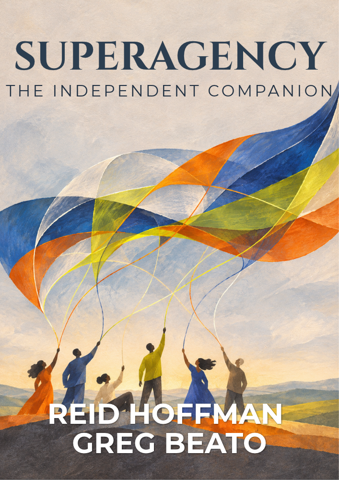
Public debate about AI often begins with what individuals and institutions might lose. Reid Hoffman and Greg Beato instead examine how widely distributed access could expand agency—while still confronting safety, governance, inequality, and the risk that benefits will not distribute themselves.
Instant New York Times and USA Today Bestseller.
Hoffman and Beato define superagency as the wider empowerment that can arise when millions of people gain access to a general-purpose technology and benefit from one another’s experiments. From that premise they explore health, education, creativity, science, and work, arguing for iterative deployment rather than precaution that freezes development. The difficult counterweight is distribution: access, literacy, market power, safety costs, and political voice determine who receives agency and who absorbs risk.
The guide follows how one person’s new capability can create spillovers, institutions, and public goods, while asking who remains excluded.
Claims about health, education, creativity, and work are separated from evidence, forecasts, and values so enthusiasm does not masquerade as certainty.
Readers can track the authors’ case for iterative learning alongside questions about regulation, concentrated power, accountability, and irreversible harm.
A careful reader can separate present capabilities from projected network effects and compare the authors’ optimism with the governance mechanisms they propose. The most productive questions concern incentives: who can stop a harmful deployment, who pays for auditing and redress, and when does learning by release impose consequences that cannot be reversed?
Technology leaders, policy readers, investors, and AI practitioners will find a clear statement of the optimistic case. Readers skeptical of Silicon Valley narratives may find it equally useful as a structured argument to interrogate rather than a neutral forecast.
Edition notice: This is an independent chapter guide and summary, not the original book. It is designed for review and reading support and is best used alongside the full work.
Miva: the next reading experience beyond audiobooks
Listen like an audiobook, then ask anything, anytime.
Start Miva's narrationMiva does not just narrate. It keeps explaining based on what you ask.