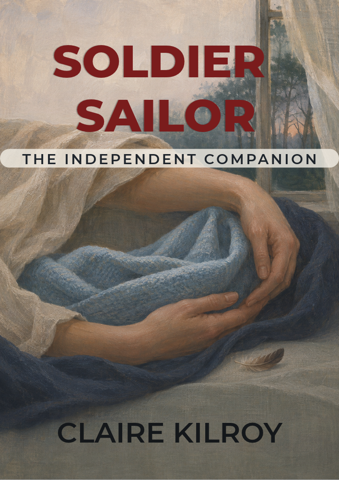
A mother addresses her young son as Sailor, but the voice speaking to him is fighting to remain a person as well as a parent. Love is absolute; exhaustion is relentless; marriage becomes a battlefield over whose time and body are treated as expendable.
2024 Women's Prize for Fiction — Shortlisted; 2024 Irish Book Awards, Eason Novel of the Year — Shortlisted
Claire Kilroy's novel compresses early motherhood into an intimate, unstable monologue.
Because the novel takes the form of a mother addressing her son, every accusation, joke, and confession reaches two listeners at once: the infant Sailor of the immediate crisis and the imagined future child who may one day understand what his mother endured. Time bends under sleep deprivation, fear, and memory rather than advancing cleanly. Kilroy refuses the comforting choice between maternal love and lost selfhood. Soldier can love her child absolutely while raging at a marriage and culture that treat her time, body, competence, and creative life as common property. The military vocabulary makes vigilance visible, but it also reveals the loneliness of being assigned total responsibility without corresponding authority or rest.
The address to Sailor also raises a question about authorship. Soldier is composing the record that her family may never otherwise preserve, choosing which moments future memory will contain. Her voice can be lyrical, comic, furious, or frighteningly immediate, and those changes are evidence of pressure rather than inconsistency. The novel's intensity comes from allowing all of those registers to remain true at once.
Follow the military imagery of vigilance, endurance, isolation, and command that structures ordinary care.
Read devotion and resentment as simultaneous experiences rather than forcing the narrator into a simple ideal or failure.
Notice how sleep, work, freedom, competence, and risk are distributed within the marriage.
For readers of intense voice-driven fiction, motherhood narratives, and psychologically precise domestic novels. Includes postpartum distress, intrusive thoughts, marital conflict, and danger involving a child.
This is an independent chapter guide and summary, not the original book. It is designed for review and reading support and is best used alongside the full work.
Miva: the next reading experience beyond audiobooks
Listen like an audiobook, then ask anything, anytime.
Start Miva's narrationMiva does not just narrate. It keeps explaining based on what you ask.