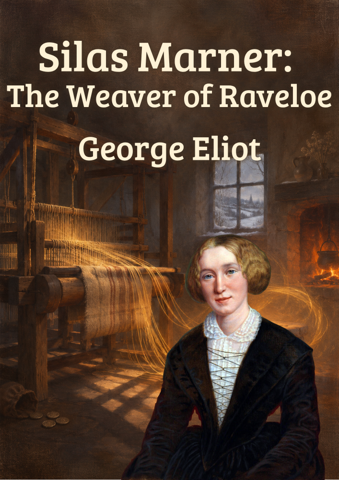
Background:
Published in 1861, the novel places religious betrayal, rural custom, industrial change, class, money, and adoption within the fictional village of Raveloe.
The central tension:
A falsely accused weaver withdraws into solitary labor and hoarded gold; an unexpected child creates a new relation to time and community. Parallel household secrets test what counts as kinship and responsibility.
How the writing works:
A compact omniscient narration, temporal leaps, parallel plots, communal speech, symbolic objects, and careful contrasts between isolation and reciprocity give the novel the density of a fable without surrendering social detail.
The novel's most memorable transformation begins with sound and touch: the relentless rhythm of Silas's loom, the hard brightness of coins counted at night, and the sudden warmth of a child beside the hearth. Eliot makes objects carry emotional habits. Gold is not simply greed; it is a substitute pattern after betrayal has emptied work and faith of social meaning. When that pattern breaks, the book asks whether attachment can be relearned without pretending the original wound never happened.
Raveloe is both comic and morally serious. Village talk misreads Silas, yet the same imperfect community eventually supplies practical care, ritual, and recognition. Parallel secrets in the Cass household prevent the story from becoming a simple fable about a good child saving a lonely man. Property, paternity, class, and the passage of time determine which claims society considers legitimate.
Its compact scale makes Silas Marner one of the best entrances into George Eliot. Readers can follow the plot in a few sittings, then return to the temporal leaps and paired households to see how carefully the apparent simplicity was built. The conclusion gains force from the contrast between what can be recovered, what cannot, and what has been made valuable by years of ordinary care.
Eliot makes Silas's inner life visible through habits before she explains it through ideas. The shuttle repeats, the coins accumulate, and the cottage closes around him. When the gold disappears and Eppie arrives, the substitution is deliberately imperfect: a child is not a moral payment for suffering, and affection cannot erase betrayal. What changes is the direction of attention. Silas must look outward, accept help, and let time create bonds that neither law nor blood can fully define.
The village is crucial to that change. Raveloe can be superstitious, comic, intrusive, and generous, often in the same gathering. Eliot refuses the fantasy that community is pure, yet she shows why isolation cannot supply recognition, memory, or care. Meanwhile, the Cass family's concealed history tests the difference between biological claim and lived parenthood. The novel's apparent simplicity becomes richer on rereading, when its paired households, time leaps, and repeated images reveal how carefully it asks what makes a life genuinely one's own.
Because the plot is so clear, every alteration in texture becomes visible: metal gives way to hair, counting to storytelling, solitary labor to shared ritual. Eliot never confuses tenderness with sentimentality; the past leaves scars, and social repair remains incomplete. Yet the book believes ordinary care can create value no theft or inheritance can duplicate. It is an ideal classic for a reader who wants emotional satisfaction without easy innocence, and philosophical depth without sacrificing the momentum of a beautifully shaped tale.
Director: Giles Foster
Production country: United Kingdom
Cast: Ben Kingsley, Jenny Agutter, Patsy Kensit
Difference from the book: compresses the long temporal development and village commentary while centering Silas's transformation and the adoption plot.
The complete two-part novel and conclusion are compact enough to read whole; notes on weaving, dissenting religion, and property are more useful than plot prompts.
The novel's treatment of adoption, chosen family, work, and moral repair has made it a durable entry point into Eliot's fiction and into debates about community beyond biological inheritance.
Miva: the next reading experience beyond audiobooks
Listen like an audiobook, then ask anything, anytime.
Start Miva's narrationMiva does not just narrate. It keeps explaining based on what you ask.