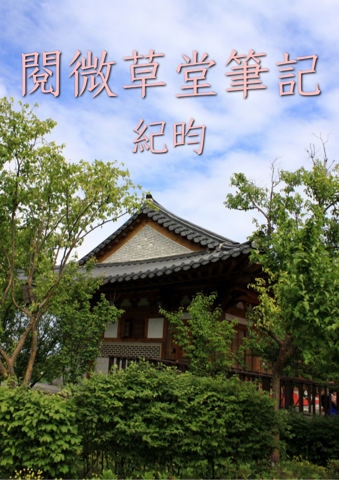
Random Jottings at the Cottage of Close Scrutiny (Yuewei Caotang Biji)
by Ji Yun
Reading Guide
Background: "Random Jottings at the Cottage of Close Scrutiny" is a collection of zhiguai (strange tales) notebooks written between 1789 and 1798, consisting of five notebooks spanning twenty-four volumes. It guides readers through non-mainstream chapters featuring ghosts, foxes, karma, omens, and social observations, highlighting Ji Yun's reasoning and ethical judgments behind the supernatural. While it shares resources of ghost stories and legends with the famous "Strange Tales from a Chinese Studio" (Liaozhai Zhiyi), it maintains its own editorial purpose and narrative pace; its independent value is best seen when placed within the context of contemporary printing, manuscript circulation, and storytelling culture.
Introduction: This book is not a linear novel but is composed of independent stories and entries. Readers will encounter interactions between humans and ghosts, strange cases, dreams, romance, gratitude, satire, anecdotes, and local lore. Different chapters use the supernatural to test human desire, integrity, and judgment. The short-form entries are suitable for casual reading, though the prefaces, postscripts, volume orders, and entry arrangements provide important clues for understanding the whole work.
Literary Features: Stories are often short and accompanied by commentary, where the narrator questions evidence, compares accounts, or offers moral interpretations; readers can observe both the strange events and the intellectual’s method of judgment. The omissions, allusions, and arguments in classical literary Chinese may pose a challenge, but they also allow the narrative to pivot within a very short space. It is recommended to notice how sources are identified at the beginning, when the supernatural enters daily life, and whether the ending affirms, doubts, or satirizes the event.
Film and Television Adaptations
No adaptations are currently listed.
Versions and Translations
Main Versions: This batch uses searchable text from Chinese Wikisource, cross-referenced with the Chinese Philosophical E-text Project, library scans, or other catalogs. Circulating editions may use titles such as "Five Types of Notebooks from the Cottage of Close Scrutiny." Ancient texts often involve traditional/simplified conversion, variant characters, volume rearranging, and later punctuation; researchers should use multiple titles when searching. Beginners may start with specific titles and then return to the prefaces and general catalog to understand the compilation; for research citations, one should verify against facsimile originals and page numbers.
Reading Tips: This collection of short stories is best approached by starting with titles, volumes, or motifs of interest before reviewing the prefaces and overall arrangement. When reading, distinguish between the layers of first-hand experience, retelling, hearsay, and commentary, and note how supernatural events affect families, local society, officialdom, and ethical judgments. Different chapters may not hold consistent attitudes toward similar ghost/fox or retribution motifs; one should not generalize the entire book based on a single story. Comparing the openings, witness identities, and concluding arguments of several chapters usually reveals the author's or editor's selection criteria. For research or citation, check textual differences across woodblock prints, manuscripts, and modern punctuated editions rather than relying on online summaries.
Publisher
BookAI
Published
2026-10-01
Miva: the next reading experience beyond audiobooks
Listen like an audiobook, then ask anything, anytime.