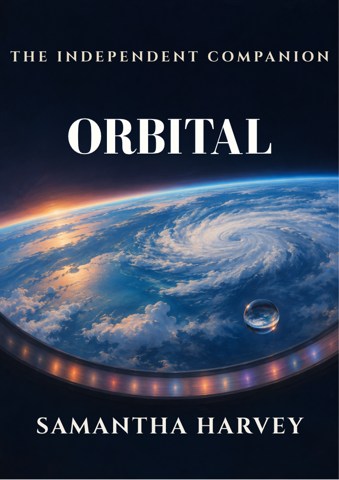
Six astronauts and crew members circle the Earth sixteen times in a single day; from orbit, national borders disappear, but news of death, family, missions, and typhoons pull them back to the human scale. This guide organizes the single-day timeline, alternating perspectives, mission routines, and recurring imagery, explaining how repetition generates transformation.
This independent guide is arranged according to the novel's precise twenty-four-hour format, marking each orbit, shift in perspective, experiment, ground message, and recurring motif, allowing repetition to be read as progression rather than stagnation.
Winner of the 2024 Booker Prize; Winner of the 2024 Hawthornden Prize.
The International Space Station allows six members to see an Earth without borders, yet it cannot detach them from family, death, national missions, and bodily needs. News of a mother's passing and a gathering typhoon transform the planet below from a spectacular sight into a place connected to concrete lives. The novel compresses a day into sixteen orbits; while seemingly cyclical, emotional and ethical pressures steadily accumulate. This guide highlights each orbit, perspective switch, ground communication, experiment, and recurring image, helping readers distinguish between mission realism, metaphor, and philosophical reflection. Ideal for readers who enjoy lyrical literature, space history, climate writing, and highly compressed forms; it is not an action-oriented space adventure and requires no background in science fiction.
The six members are not a traditional ensemble of protagonists; their individual memories surface briefly before merging back into a collective vision. Consequently, the guide focuses on how the gaze shifts from cabin objects to continents, oceans, and storms, and how the same Earth changes meaning between scientific observation, home, and political boundaries. Readers can also see how time markers, orbital velocity, and lyrical rhythm work together to provide the momentum for this short novel.
Repeated sunrises are not the same scene; geography, memory, and news change the direction of the astronauts' attention in every orbit.
From space, national borders appear fragile, yet each individual is still shaped by family, body, language, and duty.
Technical daily routines ground the lyrical passages; the guide distinguishes between mission observations, metaphors, and philosophical thoughts.
One can follow each orbit to confirm where the gaze falls—on which landmass, which private message, and which mission detail—and then compare how the same landscape changes due to memory and storms. This reading approach is particularly suited for discussing how a short-form work can accommodate a planetary scale.
Version Statement: This product is an independently produced chapter guide and summary, not the full text of the original work; it is recommended as a review and reading aid to accompany the complete book.
Miva: the next reading experience beyond audiobooks
Listen like an audiobook, then ask anything, anytime.
Start Miva's narrationMiva does not just narrate. It keeps explaining based on what you ask.