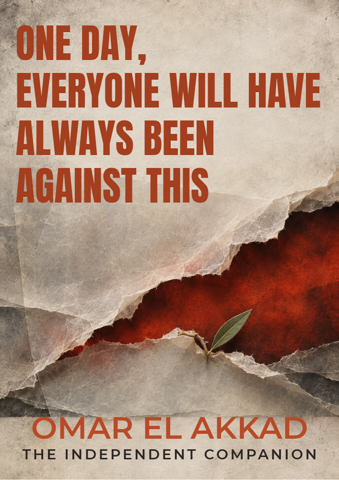
What happens when the values a society advertises collapse at the moment they are most needed? Omar El Akkad writes from the rupture between Western promises of universal dignity and the treatment of Palestinian life, combining political argument with memoir and moral witness.
2025 National Book Award for Nonfiction — Winner; 2025 Palestine Book Award — Winner; 2026 American Book Award — Winner; 2025 National Book Critics Circle Award for Criticism — Finalist
The book moves through Gaza, migration, journalism, parenthood, race, and the language institutions use to make violence tolerable.
This is not a neutral textbook attempting to supply a complete history of Gaza. It is a public account of how the author's faith in Western liberal values broke apart. El Akkad places journalism, migration, fatherhood, race, and media language beside one another to examine why some deaths are required to produce endless proof while other violence quickly receives institutional justification and the shelter of passive voice. Readers should distinguish documented events, remembered experience, rhetorical framing, and normative judgment without pretending those categories exist in isolation. The title's recurring proposition points toward delayed consensus: the comfort of condemning an atrocity only after the political and personal cost of doing so has vanished. That tension gives the essays their urgency and their accusation.
The movement between intimate scenes and public argument is deliberate. Images of the author's children, earlier reporting assignments, and encounters with institutional language test whether political vocabulary can remain abstract once a reader admits whose bodies bear its consequences. The book's repetitions function less as detached proof than as accumulated moral pressure, making disagreement possible but comfortable distance increasingly difficult.
Track how words such as order, terrorism, civilization, and objectivity acquire different meanings depending on whose suffering is visible.
Distinguish El Akkad's lived experience from the broader institutional claims he builds around it.
Examine the title's warning about moral clarity that arrives only after accountability is impossible.
For readers of political essays, media criticism, migration writing, and contemporary Middle East debate. The subject includes war, civilian death, racism, and graphic moral distress; the guide presents the author's argument rather than claiming scholarly neutrality.
This is an independent chapter guide and summary, not the original book. It is designed for review and reading support and is best used alongside the full work.
Miva: the next reading experience beyond audiobooks
Listen like an audiobook, then ask anything, anytime.
Start Miva's narrationMiva does not just narrate. It keeps explaining based on what you ask.