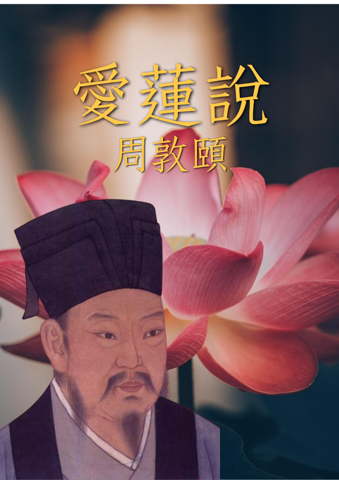
Positioning:
"On the Love of the Lotus" is a short philosophical essay by Zhou Dunyi of the Northern Song Dynasty. Starting with aquatic and terrestrial flora, the text uses Tao Yuanming's love for chrysanthemums and the widespread adoration for peonies since the Tang Dynasty as contrasts to focus on the author’s beloved lotus. Despite its brevity, it is not merely a piece of flower appreciation; the lotus's environment, posture, fragrance, and viewing distance are transformed into a language for judging character.
Structure and Rhetoric:
The first paragraph narrows the focus from various flowers to the lotus, using a series of tight, short sentences to describe it as "emerging from the mud unsullied," "hollow within and straight without," having a "fragrance that grows purer from afar," and being "fit to be viewed from a distance but not to be toyed with." These lines simultaneously evoke visual, olfactory, and spatial sensations: the lotus grows from filth, is washed by clear water, possesses a hollow yet upright stem, projects its scent, and stands independent. The second paragraph likens the chrysanthemum, peony, and lotus to the hermit, the wealthy, and the gentleman (junzi), respectively, and then questions the public's choices through these three types of "love." The essay moves from physical objects to value judgments, concluding with satire rather than lengthy moralizing.
Imagery of the Gentleman:
The lotus's being "unsullied" does not imply escaping the world, but rather maintaining oneself between the mud and the ripples; "not being seductive" is not a denial of beauty, but a refusal to seek attention through flirtation. "Hollow within and straight without" and "without creeping vines or branches" translate plant morphology into qualities of open-mindedness, integrity, and lack of sycophancy. The text also establishes an ethics of viewing: it can be admired from afar but not treated with disrespect. Thus, the gentleman can be appreciated while maintaining a distance that prevents casual possession or violation.
Reading Reminders:
Later generations often equate the "lotus" (lian) directly with the Nelumbo nucifera in modern botany, though there is scholarly debate regarding whether the text refers to the sacred lotus or the water lily. Readers may keep this ambiguity in mind without flattening ancient terminology with a single modern name. More importantly, Zhou Dunyi does not praise the lotus in isolation but establishes a hierarchy of values through the chrysanthemum, the peony, and the three types of preference.
Adaptations:
No mainstream feature films or television works based directly on the full text of "On the Love of the Lotus" have been confirmed by professional film databases at this time; therefore, no fictional titles, years, or creators are provided. The work primarily circulates through classroom recitations, calligraphy, Chinese painting, animated educational materials, garden inscriptions, and lectures. These forms are suitable for expressing the lotus's posture and the rhythm of famous lines, though focusing solely on "emerging from the mud unsullied" often neglects the complete argument formed by the chrysanthemum, peony, and the concluding rhetorical question.
Iconographic Tradition:
The theme of Zhou Dunyi observing the lotus later became a subject for painting, ceramics, calligraphy, and garden naming. Cross-media works may depict the figure by a pond or simply transcribe core sentences. Viewers should distinguish between "depictions of Zhou Dunyi and 'On the Love of the Lotus'" and general Buddhist, Taoist, or auspicious lotus patterns; the presence of a lotus does not automatically constitute an adaptation of this specific text.
Textual Source:
The selected Traditional Chinese pages identify the author as Zhou Dunyi of the Northern Song Dynasty and note the work's inclusion in the "Collected Works of Master Zhou Yuan" and "Annotated Ancient Prose." This batch preserves the ancient text and encapsulates it as an EPUB; supplementary historical commentaries are treated as research leads rather than Zhou Dunyi's original text. Punctuation, character variations, and specific wordings may differ between anthologies; citations should specify the base text.
Foreign Language Translation:
Common English titles include "On the Love of the Lotus"; in Japan, it is often called "Ai Ren Setsu" with Kakikushibun and modern translations; German versions use "Über die Liebe zum Lotus," French "L’éloge du lotus," Spanish "Amor al loto," and Vietnamese "Ái Liên Thuyết." These names prove cross-linguistic dissemination but do not imply a single standard translation exists in each market. Readers should verify the translator, source, and whether the translation is complete.
Copyright Boundaries:
The original Northern Song Literary Chinese text is in the public domain, but modern punctuation, annotations, vernacular translations, foreign language translations, calligraphy photography, and educational designs may be protected by copyright. This batch does not include modern translations found during market research in the product content.
Author:
Zhou Dunyi (1017–1073), courtesy name Maoshu, also known as Master Lianxi, was a Northern Song philosopher and official, author of "Explanation of the Taiji Diagram" and "The Universal Book." Later Neo-Confucian lineages gave him a prominent position, but the value of reading "On the Love of the Lotus" does not rely solely on his status in intellectual history; the essay itself achieves precise physical description, personality analogy, and social satire within a very short space.
Significance of the Work:
The most noteworthy aspect of "On the Love of the Lotus" is that it does not define purity as being far removed from all environments. The lotus grows in the mud, and the character of a gentleman must manifest within real-world conditions. The chrysanthemum represents withdrawal, and the peony represents wealth, while the lotus proposes a third possibility: being in the world without being assimilated, possessing beauty without being sycophantic, and remaining open and upright without being a social climber. The final line, "Who is there to join me?" both seeks a kindred spirit and prompts readers to examine their own preferences and value choices.
Miva: the next reading experience beyond audiobooks
Listen like an audiobook, then ask anything, anytime.
Start Miva's narrationMiva does not just narrate. It keeps explaining based on what you ask.