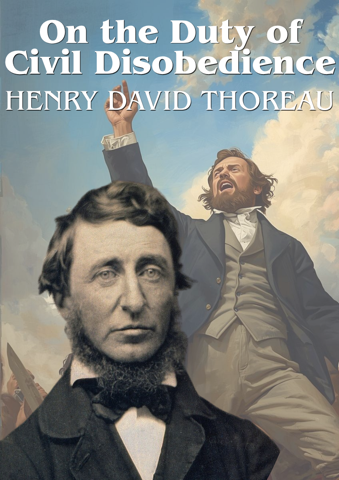
The Essay That Armed Gandhi and Martin Luther King Jr.
Written After One Night in Jail • The Blueprint for Every Non-Violent Revolution Since
From British India to the American South to Edward Snowden
The government told him to pay his taxes. He refused. He spent a night in jail. What he wrote afterward changed the course of history.
In the late 1840s, Henry David Thoreau was a man at war with his own government. The United States was expanding slavery into new territories through the Mexican-American War—a war Thoreau considered not merely unjust but a moral obscenity. His response was characteristically direct: he stopped paying his poll taxes. For six years. When the authorities finally came for him, he spent a single night in a Concord jail.
From that night came Civil Disobedience.
First published in 1849 under the title Resistance to Civil Government, the essay opens with a declaration that inverts the founding assumptions of political order: "That government is best which governs least... That government is best which governs not at all." What follows is not anarchism but something more precise and more demanding—an argument that the individual conscience is the only legitimate source of moral authority, and that a law without moral foundation has no claim on a just person's obedience.
"The true place for a just man is also a prison, when the government imprisons unjustly."
—Henry David Thoreau, Civil Disobedience
Thoreau's central argument cuts through the logic of the social contract with surgical clarity: the fact that a majority has agreed to something does not make it right. A single person standing for the truth constitutes, in his formulation, a majority of one. The citizen's duty is not compliance but conscience—to become, when necessary, a "counter-friction to stop the machine" of government when that machine produces injustice.
This was not abstract philosophy. Thoreau had lived it, paid for it, and written it from the inside.
"Thoreau's incisive logic is unanswerable. His ideas were sanctified by suffering."
—Mahatma Gandhi
"I became convinced that noncooperation with evil is as much a moral obligation as is cooperation with good."
—Martin Luther King Jr., on first reading Civil Disobedience
Gandhi discovered the essay in 1907 in South Africa and built the philosophy of nonviolent resistance—satyagraha—from its foundations, carrying it into the struggle against British colonialism that would eventually end an empire. Martin Luther King Jr. encountered it as a student and recognized in it the theoretical backbone of everything the Civil Rights Movement would become. The streets of Birmingham and Selma were, in part, Thoreau's argument made visible.
The essay has never stopped finding its moment. Edward Snowden's decision to leak NSA surveillance data was framed—by commentators and by Snowden himself—in precisely Thoreau's terms: that no moral person can patiently adjust to injustice, even when the law demands it.
One night in a Concord jail. One essay. Two centuries of revolutions.
Thoreau did not ask what the government owed its citizens. He asked what a citizen owes their own conscience. The answer has been inconvenient ever since.
Miva: the next reading experience beyond audiobooks
Listen like an audiobook, then ask anything, anytime.
Start Miva's narrationMiva does not just narrate. It keeps explaining based on what you ask.