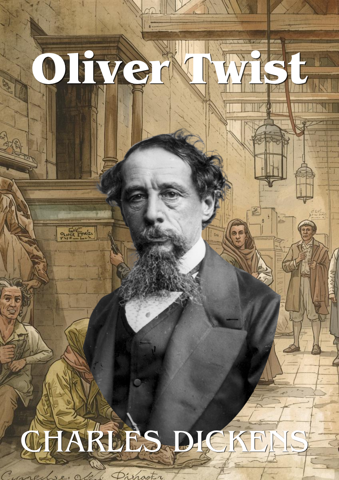
Oliver Twist is a seminal novel by Charles Dickens, first serialized between 1837 and 1839. The narrative centers on the eponymous orphan, who endures a brutal upbringing in a workhouse before escaping to London. There, he falls in with a notorious gang of pickpockets led by the sinister Fagin and the menacing Bill Sikes. As Oliver struggles to survive in the city's criminal underworld, he inadvertently uncovers secrets about his true parentage. Dickens masterfully uses Oliver's journey to expose the harsh realities of poverty, child labor, and the systemic exploitation prevalent in Victorian England, crafting a powerful social commentary and a compelling tale of innocence battling corruption.
Reading ease score: 78.7 (7th grade). Fairly easy to read.
Oliver Twist is born in a dreary workhouse, where his mother dies moments after bringing him into the world. Raised under the cold, negligent care of parish authorities and Mrs. Mann, the young orphan knows only hardship, hunger, and loneliness. When he dares to speak up for his starving companions by asking for another serving of gruel, the outraged workhouse board determines to cast him out. Apprenticed to a somber undertaker named Mr. Sowerberry, Oliver suffers further abuse from his fellow worker Noah Claypole. Driven beyond endurance, Oliver reacts violently to Noah's insults against his deceased mother and decides to run away to London. Arriving in the city exhausted and penniless, Oliver meets Jack Dawkins, a clever youth known as the Artful Dodger. Dawkins introduces him to Fagin, an old villain who leads a gang of young pickpockets. Unaware of their criminal trade, Oliver accompanies the gang into the streets, only to witness them steal a handkerchief from an elderly gentleman named Mr. Brownlow. Horror-struck, Oliver runs away, causing bystanders to mistake him for the thief. He is arrested, but the shopkeeper who witnessed the crime steps forward to prove his innocence. Taken in by the kindhearted Mr. Brownlow, Oliver experiences gentleness, comfort, and care for the first time in his life. Fagin and his violent associate, Bill Sikes, fear that Oliver might expose their operations to the authorities. They send Nancy, a young woman bound to the gang, to abduct Oliver while he is running an errand. Brought back to the den, Oliver is stripped of his new clothes and kept under close guard. Fagin attempts to warp the boy's moral nature, while Sikes forces him to participate in a house burglary in Chertsey. The break-in goes terribly wrong, and Oliver is shot in the arm. Sikes flees, leaving the wounded boy behind in a ditch. Oliver stumbles back to the house, where the compassionate residents, Mrs. Maylie and her sweet niece Rose, take him in rather than hand him over to the police. With the help of Dr. Losberne, Oliver recovers under their loving care, spending peaceful months learning to read and write in the countryside. Meanwhile, a mysterious man named Monks conspires with Fagin to destroy Oliver's reputation and push him into a life of crime, motivated by a secret hatred. Overwhelmed by remorse, Nancy secretly contacts Rose Maylie and Mr. Brownlow on London Bridge to reveal the conspiracy against Oliver. She discloses that Monks is seeking to destroy evidence of Oliver's true identity to rob him of his rightful inheritance. Sikes discovers Nancy's betrayal and brutally murders her in a fit of rage, fleeing the city in horror before accidentally hanging himself while trying to escape a vengeful mob. Mr. Brownlow tracks down Monks and exposes the truth: Monks is Oliver's half-brother, Edward Leeford. Their father had willed a portion of his estate to Oliver, provided the boy maintained an unblemished character, prompting Monks to plot his ruin. Furthermore, Rose is revealed to be the sister of Oliver's deceased mother, Agnes Fleming, making her Oliver's aunt. Fagin is captured by the police and sentenced to death, while his gang falls apart. Mr. Brownlow officially adopts Oliver, giving him the loving home he always desired. Rose marries Harry Maylie, settling down in a peaceful country village near Mr. Brownlow and Oliver, where the surviving friends live in warmth, security, and quiet happiness.
Please, sir, I want some more.Oliver Twist Chapter 2. This single line encapsulates the innocence and sheer vulnerability of childhood pitted against institutional cruelty, serving as the defining moment of Oliver's early ordeal and the novel's central indictment of the Poor Laws.
In short, the wily old Jew had the boy in his toils. Having prepared his mind, by solitude and gloom, to prefer any society to the companionship of his own sad thoughts in such a dreary place, he was now slowly instilling into his soul the poison which he hoped would blacken it, and change its hue for ever.Oliver Twist Chapter 18. It vividly illustrates Fagin's sinister methods of corruption and highlights the atmospheric horror of Oliver's isolation, showing how the novel explores the systemic fight to destroy a child's moral innocence.
She will be persuaded now,” cried the young lady. “She hesitates, I am sure.”Oliver Twist Chapter 46. This passage captures Nancy's agonizing internal conflict and fatal loyalty, revealing the devastating tragic truth of individuals who feel irredeemably trapped by their criminal environment despite their moral awakening.
She staggered and fell: nearly blinded with the blood that rained down from a deep gash in her forehead; but raising herself, with difficulty, on her knees, drew from her bosom a white handkerchief—Rose Maylie’s own—and holding it up, in her folded hands, as high towards Heaven as her feeble strength would allow, breathed one prayer for mercy to her Maker.Oliver Twist Chapter 47. It presents a deeply visceral, emotionally charged image of redemption and spiritual dignity, contrasting Nancy's ultimate piety and purity of heart against the horrific brutality of her killer.
Oliver Twist is generally considered accessible compared to many other nineteenth-century classics, carrying a high readability score that makes it suitable for readers around a middle-school level. Charles Dickens wrote the novel in serial format for popular audiences, which means the story relies on fast-paced scenes, dramatic cliffhangers, and highly vivid characterization. However, modern readers may occasionally find the sentence structures longer and the Victorian vocabulary more formal than contemporary fiction. Dickens also makes extensive use of regional slang and underworld cant, particularly in dialogues featuring Fagin, the Artful Dodger, and Bill Sikes. While these stylistic choices add immense historical realism and color to London's criminal underworld, they may require a reader to slow down during heavy dialogue sections. Overall, the central emotional narrative is so direct and compelling that the language rarely stands as a barrier to enjoyment.
Oliver Twist earned its place as a classic because it pioneered the social protest novel in English literature, combining sharp journalistic critique with powerful narrative art. Dickens was among the first major English authors to center a novel entirely on a child protagonist, using Oliver's suffering to force Victorian society to confront the consequences of industrial poverty, child labor, and the New Poor Law of 1834. Beyond its political impact, the book introduced immortal archetype characters to the culture, including the Artful Dodger, Fagin, and Bill Sikes. Its masterly blend of melodrama, Gothic terror, urban realism, and satirical humor set a new standard for serialized fiction. The novel continues to be studied and adapted because its core exploration of innocence battling systemic corruption remains universally relevant across generations.
What awaits at the end is the ultimate unraveling of a carefully constructed web of malice, identity, and fate. The shadowy origins of Oliver's birth finally break into the light, stripping away the anonymity forced upon him and forcing every enemy to confront the true weight of their transgressions. All the separate strands, including the conspiracy hatched in dark alleyways, the missing family heirlooms, and the tragic choices of those driven to betrayal, converge into a single, breathless reckoning. Innocent devotion and relentless greed reach their absolute breaking point, leaving no villain unpunished and securing a profound, long-overdue justice for a child who survived the darkest corners of Victorian London.
The scene where Oliver asks for more gruel is the thematic anchor of the entire novel, symbolizing the revolt of human need against cold, bureaucratic starvation. By documenting the exact policy of the workhouse board to reduce food portions to deter the poor, Dickens demonstrates how institutional systems treat basic human survival as a crime. Oliver's simple, polite request breaks the rigid submission expected of paupers, shocking the master and the board into viewing him as a dangerous rebel. This single moment drives the entire first act of the plot, forcing Oliver out of the workhouse and setting off his long journey toward London.
Dickens portrays London as a dual city defined by stark atmospheric contrasts between affluent comfort and filthy squalor. The criminal quarters, such as Saffron Hill and Jacob's Island, are depicted as labyrinthine, decaying mazes filled with mud, darkness, and moral pollution. In contrast, the homes of Mr. Brownlow in Pentonville and the Maylies in the countryside represent islands of light, order, and compassion. By walking his young protagonist through both worlds, Dickens uses the physical geography of the city to reflect the social and moral divides of Victorian society.
Nancy serves as the moral bridge between London's criminal underworld and the respectable middle-class world trying to save Oliver. Raised as a thief by Fagin and bound to the violent Bill Sikes, she represents the tragic outcome of a child deprived of moral guidance. Her instinct to protect Oliver from sharing her fate leads her to make dangerous choices that expose the broader conspiracy against him. Her actions highlight the novel's belief that moral redemption is possible even in the most degraded circumstances, while her internal conflict creates the story's most tragic emotional turning point.
Miva: the next reading experience beyond audiobooks
Listen like an audiobook, then ask anything, anytime.
Start Miva's narrationMiva does not just narrate. It keeps explaining based on what you ask.