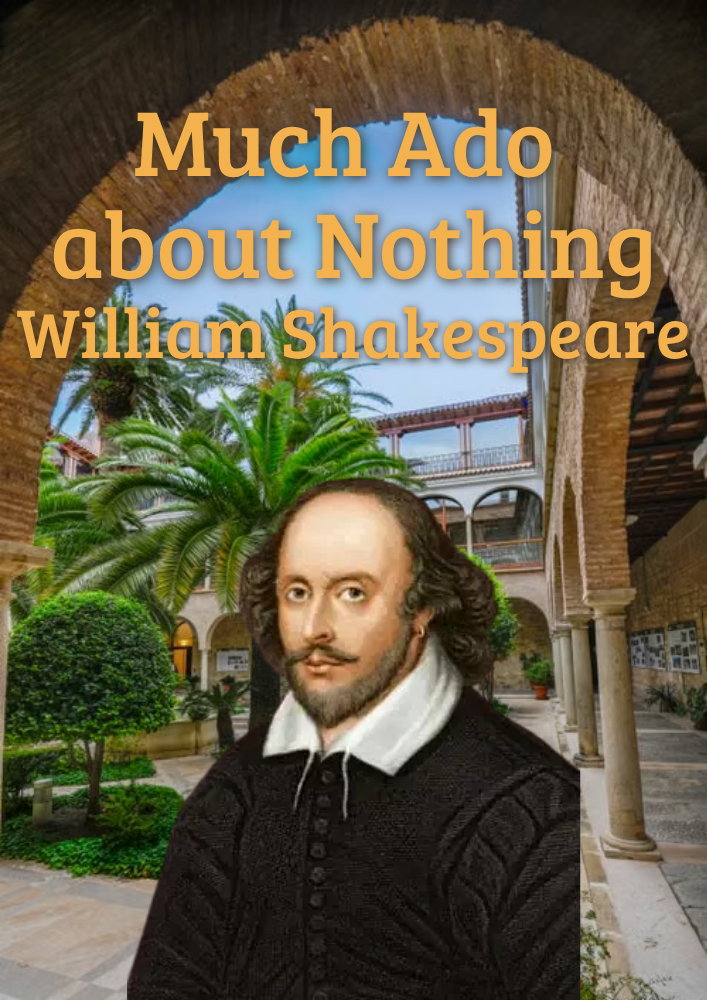
Work Background:
Much Ado about Nothing, by William Shakespeare, first appeared in c. 1598–1599. Shakespeare uses comic form to place his celebrated verbal pair beside a far more dangerous plot about female honor, allowing wit and social judgment to correct one another. Its treatment of reputation, gendered accusation, wit, and staged evidence keeps the comedy active in theatre and screen cultures well beyond its early modern setting. The comedy tests how reputation is manufactured through overheard speech, staged evidence, and public accusation, balancing a threatened marriage against Beatrice and Benedick's verbal contest. This context explains the work's choice of voice, structure, and genre, while helping readers recognize the literary setting and social institutions surrounding its first publication or performance. Readers may notice how public rules enter private judgment, how repeated images change meaning, and how form controls what can be known at each stage.
Story Overview:
After soldiers arrive in Messina, Claudio and Hero move toward marriage while Beatrice and Benedick renew their contest of wit. A malicious deception turns public celebration into accusation, and the community must learn whether speech, evidence, and reputation can be trusted. This summary identifies only the central situation and direction without revealing the ending. As speakers, settings, scale, or social positions change, earlier events take on new meanings; the work's effect lies not only in its incidents but also in pacing, point of view, silence, and the distance between what characters understand and what readers can infer.
Director: Kenneth Branagh
Production country: United Kingdom and United States
Principal cast: Kenneth Branagh, Emma Thompson, Denzel Washington, and Keanu Reeves
Difference from the book: The film uses a sunlit Tuscan estate, trims the play, and gives physical immediacy to scenes that depend on overhearing and public performance.
Director: Joss Whedon
Production country: United States
Principal cast: Amy Acker, Alexis Denisof, Clark Gregg, and Nathan Fillion
Difference from the book: Shot in black and white at a contemporary California house, it turns Messina into a modern domestic gathering while retaining Shakespeare's language.
The selected full text is the verified digital edition numbered 1519. Market titles include: Much Ado about Nothing; Beaucoup de bruit pour rien; Viel Lärm um nichts; Mucho ruido y pocas nueces; から騒ぎ; 無事生非. When choosing an edition, distinguish complete, abridged, annotated, modernized, and collected versions, and verify the translator, publisher, and year for each.
Its treatment of reputation, gendered accusation, wit, and staged evidence keeps the comedy active in theatre and screen cultures well beyond its early modern setting. Shakespeare uses comic form to place his celebrated verbal pair beside a far more dangerous plot about female honor, allowing wit and social judgment to correct one another. These qualities place the book at a specific point in the author's career and in the development of its genre. Its influence rests on recognizable questions of language, structure, history, and judgment rather than on a vague label of “classic.” Reading the full text beside another translation, stage production, or film reveals what later editors, translators, actors, and directors preserve, explain, compress, or rearrange, and brings out formal effects that summaries often conceal.
Reading another work from the same author's career also shows which concerns persist and which methods change. The book remains open to interpretation, disagreement, and rereading because readers can return to its actual language and arrangement instead of allowing later reputation to replace the experience of reading.
Miva: the next reading experience beyond audiobooks
Listen like an audiobook, then ask anything, anytime.
Start Miva's narrationMiva does not just narrate. It keeps explaining based on what you ask.