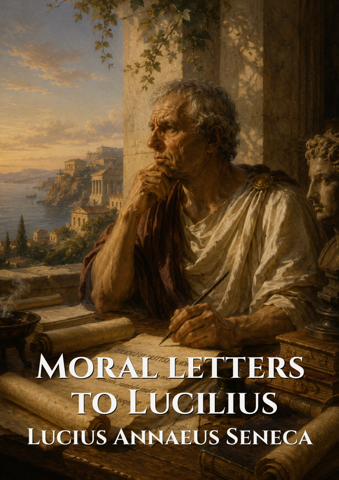
Letters from a Stoic (Epistulae Morales ad Lucilium)
Written during the final years of his life, Epistulae Morales ad Lucilium—commonly known in English as Letters from a Stoic or Moral Letters to Lucilius—is the most personal and enduring work of the Roman Stoic philosopher Seneca the Younger. The collection contains 124 surviving letters addressed to Lucilius Junior, a Roman official in Sicily, though the work was clearly intended for a broader readership rather than as private correspondence alone.
Far more than ordinary letters, the work functions as a philosophical diary, a moral handbook, and a meditation on how one should live in a world shaped by uncertainty, ambition, suffering, and death. Seneca begins many letters with simple observations from everyday Roman life—a noisy street, a public spectacle, illness, friendship, old age—and gradually transforms these moments into reflections on Stoic ethics. Through this method, ordinary experience becomes a gateway to philosophical inquiry.
The central concern of the letters is the cultivation of inner freedom. Seneca repeatedly argues that wealth, reputation, political power, and even life itself are unstable possessions. Only virtue, reason, and mastery over the self can provide lasting peace. He urges Lucilius to examine his own mind honestly, to avoid becoming enslaved by public opinion, and to confront mortality without fear. Time, in particular, emerges as one of the work’s defining themes: Seneca insists that people waste life not because it is short, but because they live without awareness or purpose.
Unlike abstract philosophical treatises, the letters possess an intimate and conversational tone. Seneca writes not as an unreachable sage but as someone struggling toward wisdom himself. He openly admits his own weaknesses, anxieties, and inconsistencies, which gives the work an unusual psychological depth for ancient literature. This human quality is one reason the letters have remained influential for nearly two thousand years.
The collection also provides vivid insight into daily life in the Roman Empire. Seneca comments on gladiatorial games, slavery, education, luxury, politics, crowds, travel, illness, aging, and social ambition. His criticism of violent entertainment—particularly in Letter 7, where he condemns gladiatorial bloodshed—is often regarded as one of the earliest surviving moral objections to such spectacles in Western literature.
Stylistically, the letters are among the finest examples of Silver Age Latin prose. Seneca combines rhetorical elegance with sharp brevity, moving fluidly between philosophical argument, irony, emotional confession, and memorable aphorisms. Many famous Stoic quotations originate from this work, including the idea that “we do not learn for school, but for life.”
The influence of Letters from a Stoic on later intellectual history has been immense. Medieval Christian thinkers admired Seneca for the ethical seriousness of his writings and sometimes even believed him sympathetic to Christianity. During the Renaissance, figures such as Michel de Montaigne and Erasmus treated the letters as models of moral reflection and literary style. In the modern world, the work remains one of the most widely read introductions to Stoicism, valued not only as philosophy but as literature of self-examination and emotional resilience.
Miva: the next reading experience beyond audiobooks
Listen like an audiobook, then ask anything, anytime.
Start Miva's narrationMiva does not just narrate. It keeps explaining based on what you ask.