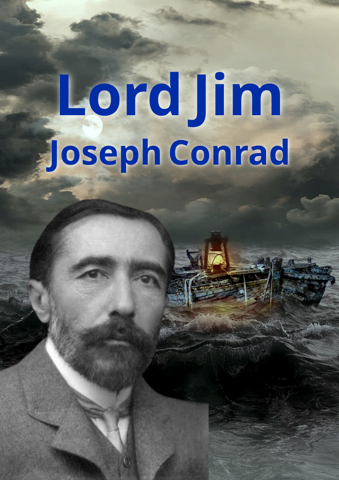
Lord Jim begins with an escape from a shipwreck, exploring how a person carries the lifelong shame of a momentary act of cowardice. Jim longs to imagine himself as a hero, yet stumbles during a real crisis; thereafter, he lives in exile across ports, courtrooms, and foreign communities, seeking a place where he can rename himself.
Joseph Conrad, born Józef Teodor Konrad Korzeniowski into a Polish noble family, became a seaman in adulthood and later wrote classics of British literature in English, his non-native language. His maritime experiences were not merely material for adventure but allowed him to witness how empire, commerce, courage, and self-deception intertwine at the borders of civilization. Lord Jim is Conrad's most painful deconstruction of the myth of masculine honor.
Modern readers can compare it to Kazuo Ishiguro’s explorations of memory and self-deception, or Ian McEwan’s novels of moral error, and it resonates with cinematic narratives where 'one mistake ruins a life.' It is not a sea adventure, but a long-term trial of conscience.
The novel’s narrative style itself mimics the loops of conscience: Marlow retells Jim's story over and over, as if by changing the angle, the young man's failure can be understood, forgiven, or rearranged into a heroic narrative. But Conrad never allows the answer to stabilize. Jim is neither a simple coward nor a misunderstood hero; he is a man tormented by his own self-imagination. He yearns for nobility, only to discover at a critical moment that he is merely ordinary, leading him to spend the rest of his life attempting to provide proof against that one second.
Within this curation, Lord Jim corresponds to shame and self-judgment. It allows readers to see that existential anxiety does not necessarily come from abstract philosophy, but can stem from an irrevocable choice. Conrad’s colonial settings further complicate this psychological drama: Jim seeks a fresh start in a foreign land, but his redemption remains entangled with imperial imagination, masculine honor, and the power of the outsider. Reading it today, it can be seen as a story of post-traumatic self-repair, but also as a skepticism toward the myth of 'restarting life': can moving to a new place truly result in a new self?
Jim begins his journey as a young, idealist merchant marine officer, driven by heroic dreams of courage and honor. However, his self-image is shattered during a fateful voyage aboard the Patna, an old steamer carrying hundreds of Muslim pilgrims. When the ship strikes a submerged object in the dark and appears on the verge of sinking, panic overtakes the crew. In a moment of paralyzing cowardice, Jim jumps into a lifeboat alongside the disgraceful captain and crew, abandoning the sleeping passengers to what he believes is certain death. To their utter shock, the Patna does not sink; it is rescued and towed into port. While the rest of the crew flees, Jim stands trial at an official court of inquiry in an Eastern port, determined to face the consequences. Stripped of his officer's certificate, he is consumed by shame and a desperate need to redeem himself. He wanders across various Eastern ports as a water-clerk, but wherever he goes, rumors of the Patna incident eventually follow, forcing him to flee again. His salvation seems to arrive when his friend Marlow introduces him to Stein, a wealthy trader. Stein offers Jim a chance to manage a remote trading post in Patusan, an isolated region in the Malay Archipelago torn apart by warring factions. Arriving in Patusan, Jim seizes the opportunity to prove his worth. He unites the local Bugis settlers led by the dignified chief Doramin, defeats the despotic Rajah Allang, and routs the ruthless bandit Sherif Ali. Through his courage and leadership, Jim restores peace, earning the deep trust and veneration of the villagers, who honor him with the title "Tuan Jim" (Lord Jim). He also wins the devotion of Jewel, a local young woman, and forms a strong brotherhood with Doramin’s son, Dain Waris. Peace endures until "Gentleman" Brown, a ruthless, desperate pirate, arrives with his starving crew on a raid up the river. Trapped on a hill by the Bugis forces, Brown negotiates with Jim. Recognizing in Brown a dark echo of his own flawed past, Jim appeals to the council to grant the intruders safe passage out of the country, boldly pledging his own life as security that no harm will come to the people. Jim’s trust is tragically betrayed. As Brown's party retreats, guided through a secret backwater by the treacherous Cornelius, they launch a cowardly ambush on Dain Waris’s river camp. Dain Waris is killed in the attack. When the young prince's body is brought back to the village, grief and fury overwhelm the community. Refusing to flee or offer excuses, Jim walks willingly to Doramin’s compound to take ultimate responsibility. As the grieving father stands over the body of his slain son, Doramin raises a pistol and shoots Jim through the chest. Jim falls dead, sacrificing his life to achieve the noble honor and redemption he had sought for so long.
To follow the dream, and again to follow the dream—and so—ewig—usque ad finem. . . .Lord Jim CHAPTER 20. It encapsulates the central existential theme of the book, framing Jim's tragic pursuit of romantic redemption as an unavoidable human necessity despite its inevitable perils.
Stein’s words, “Romantic!—Romantic!” seem to ring over those distances that will never give him up now to a world indifferent to his failings and his virtues, and to that ardent and clinging affection that refuses him the dole of tears in the bewilderment of a great grief and of eternal separation.Lord Jim CHAPTER 45. It offers a poignant final judgment on Jim's enigmatic character, weighing the lonely cost of his romantic idealism against the tragic majesty of his ultimate sacrifice.
Joseph Conrad's prose style presents a rewarding challenge for readers because he avoids a straightforward chronological narrative. Instead, the novel employs a complex nested narrative structure where the main narrator, Marlow, reconstructs Jim's life through recollection, legal testimony, and secondhand accounts. The language is rich, atmospheric, and dense with philosophical reflection, reflecting Conrad's background as an author writing in his third language. Readers who enjoy psychological depth and intricate temporal shifts will find the modern narrative techniques fascinating, while those seeking a linear adventure story may need to adapt to its looping, reflective pace.
The work stands as a foundational monument of modern literature because it broke away from traditional Victorian adventure stories to explore the fragmented nature of human consciousness. Rather than offering a simple moral lesson about courage, Conrad dismantles the myth of masculine heroism and demonstrates how self-deception can govern human choices. The novel's innovative use of an unreliable, inquiring narrator like Marlow mirrors the ambiguity of real life, where absolute truth is elusive. Its enduring power lies in its profound investigation of guilt, pride, and the universal fear that our true character might fail us when tested.
At the end of Lord Jim, the long-deferred reckoning between Jim’s private romantic vision and the uncompromising reality of his past finally arrives. What waits in the closing chapters is not a simple resolution of his guilt, but the ultimate test of his self-conception before a community that once trusted him implicitly. As Marlow gathers the remaining fragments of the story, Jim is forced to make a definitive choice about what his honor truly costs when every compromise has been exhausted. It is a moment where duty, redemption, and tragic illusion converge into a single, breathtaking action. Read these closing pages for yourself to witness how his extraordinary fate is fulfilled.
The Patna serves as the moral catalyst for the entire narrative, representing the sudden and total collapse of Jim's idealistic world. It is an aging steamer carrying hundreds of sleeping pilgrims across the ocean when it strikes an unseen object in the night. The moment Jim jumps into the lifeboat from its deck marks his transition from a promising officer to a disgraced outcast, creating the central trauma that dictates all his future decisions. The event functions as an enduring symbol of a choice that cannot be undone.
Marlow acts as the primary storyteller and moral investigator who becomes obsessed with understanding why a promising young officer would commit an act of cowardice. He attends the court of inquiry, interviews those who knew Jim, and continuously reflects on Jim's plight. Marlow's perspective provides an empathetic yet critical lens, allowing the reader to see Jim not merely as a coward, but as a complex human being wrestling with universal human weaknesses. Through Marlow, Conrad turns Jim's individual story into a broader philosophical inquiry.
"Tuan Jim" translates to "Lord Jim," a title of deep respect bestowed upon Jim by the Bugis community of Patusan. It marks his transformation from a disgraced, wandering water-clerk into a revered leader, protector, and arbitrator. However, the title carries a double meaning throughout the novel, highlighting both the genuine leadership he achieves in the jungle settlement and the subtle irony of his persistent romantic illusions of grandeur.
Miva: the next reading experience beyond audiobooks
Listen like an audiobook, then ask anything, anytime.
Start Miva's narrationMiva does not just narrate. It keeps explaining based on what you ask.