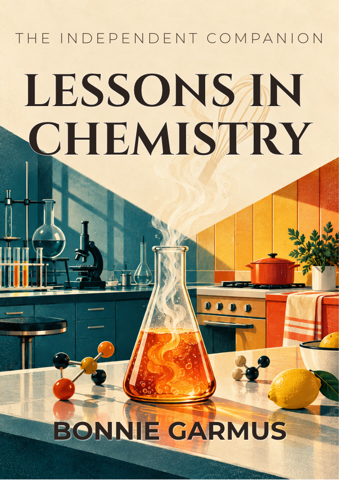
Lessons in Chemistry by Bonnie Garmus: Chemist Elizabeth Zott refuses to accept that 1950s and 1960s America has already decided what a woman may discover, say, or become. Her refusal carries her from a hostile research institute to an unlikely television kitchen, where evidence, cooking, grief, and ambition create their own reaction.
This independent chapter-by-chapter guide and book summary covers 45 titled chapters. This guide follows the novel from Hastings Research Institute to the television kitchen of Supper at Six, organizing its shifts in time and viewpoint while tracing how scientific method becomes a language for autonomy, grief, family, and public change. Use it to organize the changing viewpoints and timeline while connecting laboratory evidence, television performance, grief, comedy, and chosen family. The ending and decisive late turns remain unspoiled.
Winner — 2023 British Book Awards, Author of the Year (Bonnie Garmus); Winner — 2022 Waterstones Author of the Year (Bonnie Garmus); Winner — Paul Torday Memorial Prize.
Elizabeth’s fight is historically specific, yet the pressure to make competence more agreeable remains recognizable. The novel’s mixture of anger, comedy, science, and chosen family gives readers several ways into a story about who is permitted to be authoritative.
Elizabeth approaches prejudice with the same insistence on evidence that she brings to chemistry. The guide traces how that clarity creates both conflict and comedy as laboratories, employers, television executives, and viewers attempt to make her more acceptable.
Cooking gives Elizabeth a public language for chemistry, independence, and ambition. Chapter notes connect ingredients and experiments to the larger transformation of a daytime program into an unexpected invitation for women to take their own abilities seriously.
Calvin, Madeline, Harriet, and Six-Thirty complicate the idea of who gets to count as family or even as a narrator. The companion maps the novel’s viewpoint and time shifts so that grief, hidden history, and comic observation reinforce rather than obscure one another.
This guide is ideal for readers of historical fiction, workplace narratives, and women-in-STEM stories who want an accessible chapter map and thematic discussion prompts. It offers more than a plot recap by connecting structure, character pressure, recurring language, and ethical questions while leaving room for your own interpretation.
Edition notice: This is an independent chapter guide and summary, not the original book. It is designed for review and reading support and is best used alongside the full work.
Miva: the next reading experience beyond audiobooks
Listen like an audiobook, then ask anything, anytime.
Start Miva's narrationMiva does not just narrate. It keeps explaining based on what you ask.