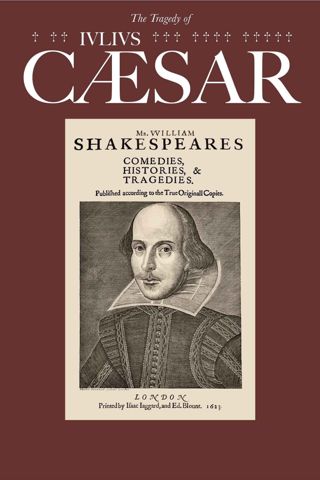
William Shakespeare's "Julius Caesar" is a renowned historical tragedy, first performed in 1599, that vividly dramatizes the conspiracy against the Roman dictator Julius Caesar and the subsequent civil war that engulfs Rome. While named after Caesar, the play primarily centers on Marcus Brutus, a respected Roman senator grappling with the profound conflict between his personal loyalty to Caesar and his perceived civic duty to prevent what he believes could be Caesar's tyrannical rule. The dramatic assassination of Caesar sets off a chain of events, leading to a fierce power struggle as Mark Antony skillfully manipulates public opinion against the conspirators through his powerful rhetoric. The ensuing war and its tragic consequences explore timeless themes of political morality, the persuasive power of rhetoric, ambition, betrayal, and the inherent fragility of republican government.
Reading ease score: 88.9 (6th grade). Easy to read.
Rome burned not with fire, but with ambition and the fatal clash of ideals. In William Shakespeare’s tragic masterpiece, the shadow of ultimate power falls over the Roman Republic as Julius Caesar returns triumphant from victory. The citizens celebrate, yet beneath the cheers, whispers of fear and envy take root among the senators. A shadowy conspiracy forms, led by the calculating Cassius, who sees Caesar’s rising star as a death sentence for Roman liberty. To give their dangerous plot legitimacy, Cassius targets Marcus Brutus, a nobleman held in the highest esteem for his stoic virtue and unyielding patriotism. Brutus loves Caesar as a dear friend, but he loves Rome more. Tortured by internal conflict, Brutus wrestles with his conscience in the quiet of his garden. He convinces himself that Caesar is a serpent’s egg, harmless while unhatched, but bound to grow treacherous once crowned. For the sake of the Republic’s future, Brutus joins the conspirators, insisting their deed must be a noble sacrifice, not a bloody butchery. Warnings pour in from every corner, yet Caesar’s arrogance blinds him. A fortune-teller’s cryptic warning to "Beware the Ides of March," strange portents in the night sky, and the terror-filled nightmares of his wife, Calpurnia, are all dismissed. Driven by pride and coaxed by the conspirators, Caesar walks directly into the Senate House on the fateful fifteenth of March. There, surrounded by men he deemed friends, the trap springs. Daggers flash in the air, piercing Caesar repeatedly. The final, crushing blow comes not from the iron of a blade, but from the sight of his trusted ally step forward. "Et tu, Brute?" Caesar gasps, resigning himself to death as his blood stains the marble floor. In the chaotic aftermath, Brutus steps before the panicked Roman public. With measured, rational eloquence, he defends the assassination, convincing the crowd that Caesar had to die so that Romans might live as free men. But Brutus makes a fatal miscalculation: he allows Mark Antony, Caesar’s fiercely loyal general, to speak at the funeral. Antony ascends the pulpit and delivers a masterclass in manipulation. Repeating with sharp irony that Brutus is an "honorable man," Antony subtly tears down that honor piece by piece. He reminds the crowd of Caesar’s love for them, shows his blood-soaked mantle, and reads Caesar’s generous final will. Emotion turns to fury. The crowd erupts into a violent mob, burning the conspirators' homes and driving Brutus and Cassius out of Rome. Civil war tears the empire apart. Antony, alongside Caesar’s young heir Octavius and Lepidus, forms a triumvirate to hunt down the assassins. Meanwhile, on the plains of Philippi, tension and grief fracture the conspirators. Brutus is haunted not only by the suicide of his heartbroken wife, Portia, but by the midnight apparition of Caesar’s ghost, promising they will meet again on the battlefield. When the clash of armies begins, miscommunications and despair seal their fate. Believing all is lost, Cassius commands his servant to strike him down with the very blade used on Caesar. Upon learning of Cassius’s death and facing inevitable defeat, Brutus chooses honor over dishonor. Refusing to be paraded through Rome as a captive, he runs upon his own sword, declaring that Caesar’s spirit may finally rest. Standing over the body of his fallen foe, Mark Antony recognizes the tragic truth of the catastrophe. Brutus alone fought out of a genuine love for the Republic, while the others acted out of envy. Calling him "the noblest Roman of them all," Antony orders full military honors for the fallen idealist, bringing a somber end to a world destroyed by the price of power.
Men at sometime, are Masters of their Fates. The fault (deere Brutus) is not in our Starres, But in our Selues, that we are vnderlings.Julius Caesar Act I, Scene 2. This passage establishes the central philosophical tension between free will and destiny in political action, framing tyranny not as an inevitable fate decreed by the stars, but as the consequence of human passivity and political hesitation.
Cowards dye many times before their deaths, The valiant neuer taste of death but once.Julius Caesar Act II, Scene 2. It succinctly articulates a stoic philosophy toward mortality and leadership, demonstrating Caesar's tragic pride and unflinching refusal to display public fear even when faced with immediate physical threat.
If then, that Friend demand, why Brutus rose against Caesar, this is my answer: Not that I lou'd Caesar lesse, but that I lou'd Rome more.Julius Caesar Act III, Scene 2. It encapsulates the tragic core of Brutus's character by presenting his treason as a noble sacrifice, balancing personal loyalty against civic duty through memorable rhetorical parallelism.
Friends, Romans, Countrymen, lend me your ears: I come to bury Caesar, not to praise him.Julius Caesar Act III, Scene 2. As one of the most celebrated opening lines in Western drama, it initiates a masterclass in political rhetoric and crowd manipulation under the guise of an unassuming funeral eulogy.
Shakespeare's historical tragedy is widely recognized as one of his most accessible plays, earning a high reading ease score equivalent to a standard sixth grade level. The language is direct, dramatic, and focused on clear political conflicts, making the narrative structure simple to follow. While the dialogue features traditional Elizabethan verse and rhetorical figures of speech, the central arguments between characters are grounded in clear human emotions like loyalty, fear, and honor. Readers quickly adapt to the rhythm of the speeches, especially since the tension of the conspiracy keeps the pace moving swiftly from the opening scene to the tragic climax.
The play remains a timeless classic because it explores the universal dilemmas of political morality, power, and the consequences of political violence. Shakespeare presents a nuanced portrait of political conflict where no single figure is entirely innocent or purely evil. Through characters like Brutus and Mark Antony, the text examines how noble ideals can be corrupted by political necessity and how public opinion can be swayed by rhetorical skill. Its psychological depth, iconic speeches, and profound reflection on the fragile nature of democratic government make it continually relevant to readers in every era.
Beyond the political debates and the turmoil of Rome lies the final reckoning on the battlefield of Philippi. What awaits in the concluding sequences is not merely the resolution of a military campaign, but the profound emotional confrontation between men and the inescapable consequences of their choices. Here, the conflicting ideals that tore the Republic apart meet their ultimate test as personal guilt, broken friendships, and old prophecies converge. Who holds their ground, which leader maintains his honor, and how the ghost of Caesar is finally laid to rest are the exact payoffs worth discovering in the text. Read these closing pages for yourself to experience the tragic climax.
Although the play bears the name of Julius Caesar, Marcus Brutus serves as the primary tragic protagonist of the story. The narrative centers on Brutus's internal moral conflict, tracking his agonizing decision to join the conspirators, his justification of the murder, and his tragic downfall during the civil war. Caesar's life ends mid-way through the play, but Brutus's conscience and choices drive the dramatic arc from the beginning to the final scene.
The famous Latin phrase translates to "And you, Brutus?" and captures the ultimate emotional climax of Caesar's assassination. Spoken as Caesar recognizes his trusted friend among his attackers, the line highlights the theme of personal betrayal over political principle. It marks the precise moment Caesar ceases to fight for his life, realizing that his close personal bond could not overcome the political forces aligned against him.
Mark Antony turns the Roman crowd through a masterclass in irony and emotional manipulation during his famous funeral oration. By repeatedly referring to Brutus and the conspirators as "honorable men" while presenting physical evidence of Caesar's love for the people, Antony creates a stark contrast between Brutus's words and the reality of the assassination. He shows the crowd Caesar's wounded body and reads his generous final will, transforming the citizens' rational support for Brutus into intense outrage.
Miva: the next reading experience beyond audiobooks
Listen like an audiobook, then ask anything, anytime.
Start Miva's narrationMiva does not just narrate. It keeps explaining based on what you ask.