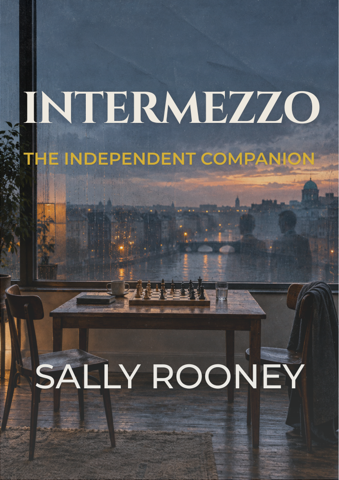
Intermezzo by Sally Rooney begins with two brothers who have lost the same father but cannot agree on how to grieve—or how to love the people now drawing them in different directions. Peter hides disorder behind professional confidence; Ivan trusts the logic of chess more easily than the judgments of his older brother.
This independent literary fiction chapter guide follows the novel’s three parts and seventeen chapters. It helps readers distinguish the brothers’ sharply different voices, trace the relationships involving Sylvia, Naomi, and Margaret, and see how age, money, illness, shame, and family history reshape apparently private choices.
Peter is a successful Dublin lawyer in his thirties whose apparent competence gives way after his father's death. He struggles to sleep and moves between Sylvia, his enduring first love, and Naomi, a younger woman whose relationship to money and social convention differs sharply from his own. Ivan, a twenty-two-year-old competitive chess player who considers himself socially awkward, begins an intense relationship with Margaret, an older woman carrying a complicated past. Their choices expose years of rivalry and misreading between the brothers.
The guide identifies shifts in consciousness and explains how Rooney gives the brothers distinct syntactic and emotional rhythms. It compares how a meeting, argument, or silence is remembered and defended by different people. Money, age, marriage, chronic pain, social respectability, and family obligation are treated as pressures inside intimacy rather than separate background topics.
Peter and Ivan share a loss but cannot agree on what mourning should look like or what brothers owe one another. New grief draws older injuries and failures of care back to the surface.
Ivan's chess calculation and Peter's legal intelligence both depend on inference, yet neither prevents emotional error. The novel repeatedly tests the distance between being clever and understanding another person.
Age gaps, money, illness, marriage, and prior commitments shape the relationships characters believe they are allowed to pursue. The novel keeps incompatible judgments in tension rather than resolving them into an easy rule.
For readers interested in contemporary literary fiction, sibling conflict, bereavement, chess, unconventional relationships, and close attention to style. The guide is especially helpful for readers who want to distinguish viewpoints, trace relationship changes, or revisit the novel's ethical questions without flattening it into a plot summary.
Edition notice: This is an independent chapter guide and summary, not the original book. It is designed for review and reading support and is best used alongside the full work.
Miva: the next reading experience beyond audiobooks
Listen like an audiobook, then ask anything, anytime.
Start Miva's narrationMiva does not just narrate. It keeps explaining based on what you ask.