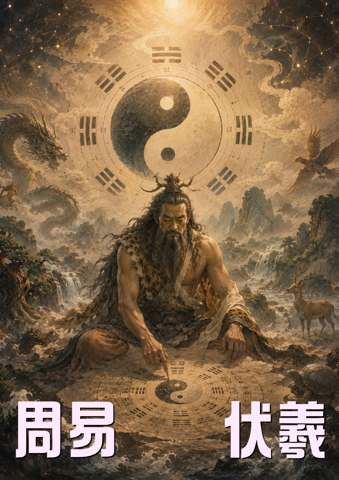
I. Core Overview and Philosophical Positioning of the I Ching
The I Ching, also known as the Zhou Yi, is one of the most foundational classics in Chinese literature. Throughout its long historical evolution, it has maintained a dual identity:
Practical Level (Book of Divination): It was originally a divination tool used by ancient Chinese shamans and rulers to deduce future fortunes and misfortunes. Diviners would consult the spirits, obtaining hexagrams through specific rituals (such as the yarrow stalk method) to predict the success or failure of national affairs like war, politics, and harvests, or individual destinies.
Philosophical Level (Source of the Great Tao): Since being honored as one of the "Five Classics" in the Han Dynasty, the I Ching has transcended simple divination. It employs a sophisticated symbolic system (Yin-Yang, the Eight Trigrams, and the Sixty-Four Hexagrams) to describe the movement and transformation of all things in the universe, becoming the cornerstone of cosmology, transformation theory, and moral philosophy in classical Chinese culture. Its thought has profoundly influenced various fields including politics, medicine, astronomy, mathematics, military strategy, and the arts.
II. Meaning of the Name and Etymological Research
Lizard Hieroglyph Theory: The "Shuowen Jiezi" suggests that "Yi" is the original character for "lizard," a pictograph representing the creature's ability to change its camouflage to match its environment, symbolizing "change."
Dual-Vessel Pouring Theory (Modern Oracle Bone Script Research): Modern scholars like Guo Moruo and Xu Zhongshu, through examining oracle bone and bronze inscriptions, point out that "Yi" was actually an ancient form of "Yi" (益 - benefit/increase), symbolizing hands holding a pot and pouring water or wine from one container to another. Its original meaning was "to bestow," which later extended to mean benefit, change, and exchange.
In the Eastern Han Dynasty, the great scholar Zheng Xuan summarized the core philosophy of "Yi" in his "Treatise on Yi" as the "Three Meanings of Yi":
Simplicity (Jian Yi): Reducing complexity to simplicity, using the most basic Yin and Yang symbols to summarize the fundamental laws of the universe.
Changeability (Bian Yi): Everything in the world is in a state of constant change (Yin waning and Yang waxing, in a continuous cycle).
Invariability (Bu Yi): Behind the constant renewal and change of all things, the operating "Tao" (laws) remains an eternal and unchanging truth.
Universality: Zheng Xuan of the Eastern Han Dynasty argued that "Zhou" means "comprehensive and pervasive," implying that the wisdom of the Yi Tao is all-encompassing, cyclical, and universally applicable.
III. Historical Evolution: The Three Yi and Composition Debates
Lianshan: Said to be the Yi of the Xia Dynasty, beginning with the "Gen" hexagram (Mountain), symbolizing continuous mountain ranges.
Guicang: Said to be the Yi of the Shang Dynasty, beginning with the "Kun" hexagram (Earth), signifying that all things return to and are stored within the earth. In 1993, Qin Dynasty bamboo slips unearthed at Wangjiatai, Jiangling, Hubei, highly matched historical fragments of the "Guicang," leading to the belief that they represent the re-emergence of the ancient text.
Zhou Yi: The Yi of the Zhou Dynasty, beginning with the "Qian" hexagram (Heaven), and the only one of the three to be passed down in its entirety. Therefore, later generations usually refer specifically to the "Zhou Yi" when speaking of the "I Ching."
Modern Archaeology and Collective Authorship: Since the 20th century, scholars have conducted comparative studies using Shang and Zhou oracle bones, bronze inscriptions, and the silk manuscript of the I Ching unearthed from the Mawangdui Han Tomb in 1973. They propose that the Zhou Yi was not the work of one person at one time, but was composed around the late Western Zhou (approx. late 9th century BC). It is a collection of texts created collectively by various divination officials of the Western Zhou, who compiled long-accumulated divination records, folk songs, and historical events. Scholars like Zhang Zhenglang have pointed out that the odd and even numerical symbols on Zhouyuan oracle bones are the original prototypes of the transition from "numerical divination" to "linear hexagram drawings."
IV. The Zhou Yi and the "Ten Wings" (Yi Zhuan)
In a broad sense, the I Ching consists of two organic parts: the "Classic" (Jing) and the "Commentary" (Zhuan):
I Ching (Classic): This is the core body of "hexagram drawings, judgments, and line statements" left from the era of King Wen and the Duke of Zhou. The content is archaic and obscure, consisting mostly of specific divination records.
Yi Zhuan (Commentary / Ten Wings): Because the language of the "Classic" had become difficult to understand by the Warring States period, Confucian and Taoist scholars wrote systematic annotations and philosophical elaborations to explain the Zhou Yi. Tradition attributes these to Confucius, but modern scholarship mostly identifies them as collective works by Confucian and Taoist scholars from the Warring States to the early Han Dynasty.
The Yi Zhuan consists of seven categories and ten essays, collectively known as the "Ten Wings" (implying they provide ten wings for the Zhou Yi to fly):
Tuan Zhuan (Commentary on the Decision), Parts I & II: Determines the main meaning of a hexagram.
Xiang Zhuan (Commentary on the Images), Parts I & II: Uses hexagram images to elaborate on the moral cultivation of the gentleman (Great Image) and explains the characteristics of individual lines (Small Image).
Xici Zhuan (Commentary on the Appended Phrases), Parts I & II: A general treatise and philosophical outline of the I Ching, discussing cosmology and the principles of divination.
Wen Yan Zhuan (Commentary on the Words): Specifically provides an in-depth explanation of the moral connotations of the "Qian" and "Kun" hexagrams.
Shuo Gua Zhuan (Discussion of the Trigrams): Explains the natural phenomena and classifications of all things represented by the Eight Trigrams.
Xu Gua Zhuan (Sequence of the Hexagrams): Explains the logical cause and effect of the order of the Sixty-Four Hexagrams.
Za Gua Zhuan (Miscellaneous Hexagrams): Pairs hexagrams with opposite qualities and explains their intricate changes in concise language.
V. Line and Hexagram Structure and Binary Correspondence
The I Ching established a highly abstract binary symbolic system to simulate a dynamic world:
Trigrams (Bagua): Composed of three lines stacked from bottom to top, forming eight possible combinations (Qian, Dui, Li, Zhen, Xun, Kan, Gen, Kun).
Hexagrams: By stacking two trigrams, sixty-four combinations are formed, known as the "Sixty-Four Hexagrams." Each hexagram has six lines, named from bottom to top as: First, Second, Third, Fourth, Fifth, and Top.
Wuji ➔ Taiji (Great Ultimate) ➔ Liangyi (Yin and Yang) ➔ Sixiang (Four Images) ➔ Eight Trigrams ➔ Sixty-Four Hexagrams.
However, modern historians (such as Guo Shuchun and Liang Zongju) have clarified a common historical misunderstanding: it was not the Eight Trigrams that led Leibniz to invent binary. In fact, he had already independently invented binary and only later discovered that the ancient Chinese trigrams could be perfectly symbolized and interpreted through his mathematical theory.
VI. Transmission and the Two Main Schools of Yi Studies
When Qin Shi Huang burned books and buried scholars, the Zhou Yi was spared because it was classified as a book on medicine and divination, allowing it to be preserved intact. Over two thousand years, research has diverged into two main schools:
School of Images and Numbers (Xiangshu):
Core Tenet: Focuses on the concrete images, numerical proportions, and chart changes symbolized by the Eight Trigrams to deduce the laws of the universe and divine fortune.
Representative Figures: Jing Fang and Zheng Xuan of the Han Dynasty, and Shao Yong of the Song Dynasty (who developed the Hetu, Luoshu, and Xiantian charts).
School of Meanings and Principles (Yili):
Core Tenet: Opposes excessive obsession with mysterious divination techniques and advocates for uncovering the philosophical thinking, political wisdom, and moral ethics behind the hexagram names and line statements.
Representative Figures: Wang Bi of the Wei-Jin period (who advocated "grasping the meaning and forgetting the image"), Cheng Yi of the Northern Song, and Zhu Xi of the Southern Song.
Modern Research and "Changes AI"
In modern times, the master of Western psychology Carl Jung studied the I Ching deeply, proposing the "Principle of Synchronicity" to explain the effectiveness of I Ching predictions. In the 2010s, with the explosion of Big Data and Artificial Intelligence (AI), I Ching research entered a new phase called "Changes AI." This school attempts to use AI algorithms to expand the dynamic simulation of the Sixty-Four Hexagrams; simultaneously, scholars seek to draw upon the philosophical wisdom of Yin-Yang harmony and the idea that "things turn into their opposites at their extremes" as an ethical framework to constrain and guide the safe development of AI.
Miva: the next reading experience beyond audiobooks
Listen like an audiobook, then ask anything, anytime.
Start Miva's narrationMiva does not just narrate. It keeps explaining based on what you ask.