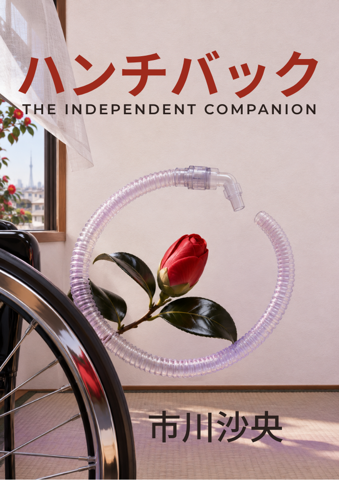
Izawa Shaka, a woman with severe disabilities living in a group home, writes provocative prose online, sharply critiquing the notions of sex and reproduction that able-bodied people take for granted. When a caregiver discovers her anonymous identity, the power dynamics of desire, money, and care begin to shift precariously.
Winner of the 169th Akutagawa Prize (2023); Winner of the 128th Bungakukai Newcomers' Award (2023); The English translation by Polly Barton was longlisted for the 2025 International Booker Prize.
Saou Ichikawa’s Hunchback uses humor and provocation to invert the gaze that confines people with disabilities to roles of pure beings or passive objects.
Though the work is short, it moves rapidly between provocation, black humor, physical discomfort, and literary criticism. Shaka is not a character waiting for the understanding or salvation of the able-bodied. Using her skills as an anonymous writer, her knowledge, and her money, she intentionally reshuffles the positions of the observer and the observed. However, within the reality of requiring care, no transaction is free from the asymmetry of power. References to the weight of paper books, the posture required to turn pages, and the locations of reading are not peripheral topics but central questions posed to publishing culture. When literature speaks of the value of reading, has it ever imagined a reader who cannot hold a book in a standard posture? This work originates expressions of desire and critiques of the reading environment from the same body, shaking the very concept of "normal" in literature.
Furthermore, anonymity is not a mask that detaches Shaka from reality, but a technique to create a voice by exploiting physical constraints. Who reads her text as a commodity, and who sees her body as an object of care? At the moment these two gazes overlap, the reader can no longer remain a safe observer. The short format itself serves as a device to leave discomfort and questions behind without over-explaining.
Examine where Shaka holds agency by analyzing the differences between her anonymous blog, commercial writing, and internal monologues.
Follow why consent and power do not fit into a simple formula when sex, money, and care intersect.
Consider which readers are standardized by literary forms through the discussions surrounding physical paper books.
For readers interested in contemporary fiction surrounding disability representation, the body, gender, and literary institutions. Contains strong language regarding sex, reproduction, care, and eugenics.
This product is an independent chapter-by-chapter guide and summary, not the full text of the original work. Please use it alongside the original book for review and reading support.
Miva: the next reading experience beyond audiobooks
Listen like an audiobook, then ask anything, anytime.
Start Miva's narrationMiva does not just narrate. It keeps explaining based on what you ask.