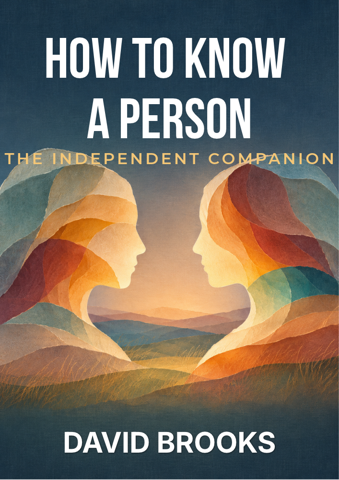
Many people are surrounded by conversation yet still feel unseen. Brooks asks what kind of attention, questioning, and interpretation allows one person to encounter another as a complex life rather than a category or problem to solve.
Brooks argues that feeling unseen is not solved by collecting more facts about one another. The deeper shift begins when attention changes—from waiting for a turn to speak to asking what story this person believes they are living, what they fear losing, and what possibility they have not yet learned to name.
New York Times bestseller.
The guide tracks illuminators and diminishers, accompaniment, life stories, difficult conversations, character, despair, and the social practices through which recognition becomes visible.
Brooks contrasts habits that enlarge another person's presence with habits that reduce them to a type, résumé or problem. The distinction gives readers a practical way to examine attention before reaching for conversational techniques.
Knowing facts about someone is not the same as understanding the plot they believe they are living. The guide follows Brooks from everyday conversation to life stories, character and suffering, showing how questions can uncover values, transitions and the meanings people give events.
Attention can be offered, but trust cannot be forced. This lens keeps mutuality, power and safety visible while examining accompaniment, disagreement and despair, preventing the book's moral aspiration from becoming a demand for unlimited disclosure.
Readers can use the chapter guide to move beyond generic advice to listen better. It distinguishes perception, questioning, interpretation and accompaniment, making the book useful for managers, teachers, parents, interviewers and anyone who senses that efficient conversation is not the same as human recognition. Open the full book for the stories in which a person's moral imagination changes through sustained attention. They show why seeing is not a clever interview technique but a discipline that asks the observer to become less hurried and less certain.
The book blends research, reporting, philosophy, and moral reflection. Its practices can improve attention, but they do not guarantee reciprocity or make unsafe relationships safe.
Edition notice: This is an independent chapter guide and summary, not the original book. It is designed for review and reading support and is best used alongside the full work.
Miva: the next reading experience beyond audiobooks
Listen like an audiobook, then ask anything, anytime.
Start Miva's narrationMiva does not just narrate. It keeps explaining based on what you ask.