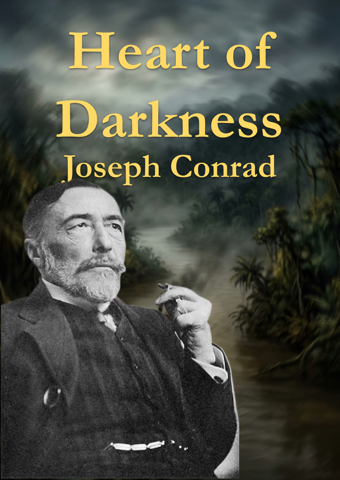
Joseph Conrad's seminal novella, 'Heart of Darkness,' published in 1899, follows the sailor Charles Marlow as he recounts his harrowing journey up the Congo River. Employed by a Belgian trading company, Marlow's mission is to locate the enigmatic ivory trader, Kurtz, who has established a mysterious and unsettling presence deep within the African interior. As Marlow delves deeper into the continent, he confronts the brutal realities of European colonialism, the corrupting influence of power, and the ambiguous nature of morality. The narrative masterfully blurs the lines between civilization and savagery, offering a profound and dark meditation on imperialism and its psychological toll. Conrad draws unsettling parallels between the 'darkness' found in the heart of Africa and the moral shadows lurking within European society, particularly London, making it a timeless exploration of human nature and the destructive forces of unchecked ambition.
Reading ease score: 80.2 (6th grade). Easy to read.
Heart of Darkness begins aboard the anchored yawl Nellie on the River Thames at dusk. As night falls, a seasoned sailor named Marlow breaks the silence among his companions by reflecting on the dark, untamed history of Britain under Roman conquest. He then transitions into recalling his own journey years earlier as a steamboat captain for a European ivory trading company in the African interior. Driven by a lifelong fascination with maps and unexplored regions, Marlow secured his command with the help of his influential aunt in Europe. Upon arriving at the Company’s coastal and central stations, however, he was immediately confronted with the brutal reality of European imperialism. Instead of bringing enlightenment, the colonizers brought chaos, exploitation, and moral ruin. Marlow observed emaciated native laborers dying in chains, broken equipment abandoned in the dirt, and Company agents, whom he viewed as petty opportunists, obsessed solely with acquiring ivory. Amid this dysfunction, Marlow repeatedly heard the name of Mr. Kurtz, a legendary agent in charge of the company's most remote inland station. Kurtz was widely celebrated as a charismatic prodigy, an artist, and an emissary of progress who sent back more ivory than all other stations combined. Fascinated by Kurtz’s reputation, Marlow spent months repairing his damaged steamboat to navigate the treacherous river toward Kurtz's outpost. The voyage upriver into the dense, silent wilderness proved physically arduous and psychologically suffocating. Surrounded by impenetrable jungle and heavy fog, Marlow felt as though he were traveling back to the dawn of time, sensing a primal, universal human connection to the untamed landscape. Before reaching the station, the steamboat was ambushed by natives shooting arrows through the mist, resulting in the death of Marlow's African helmsman. Upon reaching the inner station, Marlow met a naive young Russian adventurer who revealed that Kurtz had completely abandoned European moral restraints. Kurtz had established himself as a demigod among the local tribes, who worshipped him and engaged in violent night rituals. The brutality of his reign was starkly visible: human heads were severed and mounted on wooden stakes outside his dwelling. Though Kurtz had originally written an eloquent, idealistic report for the International Society for the Suppression of Savage Customs, he had later scrawled a horrifying postscript at the bottom: "Exterminate all the brutes!" Marlow found Kurtz gravely ill, physically wasted, but still possessing a powerful, commanding voice. Despite Kurtz’s attempts to flee back into the forest to join his followers, Marlow persuaded him to return to the steamboat. As the vessel traveled back downriver toward civilization, Kurtz’s health rapidly deteriorated. In his final moments on his deathbed, Kurtz experienced a profound moment of spiritual reckoning, crying out in a whisper his haunting final words: "The horror! The horror!" He died shortly after and was buried in the mud along the riverbank. Marlow returned to Europe deeply shaken and disillusioned by the hypocrisy of civil society. A year later, he visited Kurtz’s grieving fiancée to return his remaining letters and portrait. Still holding an idealized image of Kurtz as a noble genius, she begged Marlow to tell her his final words. Divided between revealing the dark truth and offering compassion, Marlow lied, telling her that Kurtz had died with her name on his lips. The narrative concludes back on the Thames, with Marlow falling silent as the river flows beneath an overcast sky into an immense, enveloping darkness.
What thrilled you was just the thought of their humanity—like yours—the thought of your remote kinship with this wild and passionate uproar.Heart of Darkness Section II. It forces the reader to confront Conrad's radical assertion that the boundary between "civilized" and "savage" is an illusion, exposing a universal human kinship rooted in primal instincts.
Did he live his life again in every detail of desire, temptation, and surrender during that supreme moment of complete knowledge? He cried in a whisper at some image, at some vision—he cried out twice, a cry that was no more than a breath: ‘The horror! The horror!’Heart of Darkness Section III. This iconic climax encapsulates Kurtz's ultimate judgment on his own moral collapse and the dark reality of human nature, serving as the emotional and philosophical peak of the story.
Yes, many readers find the novella challenging due to Joseph Conrad's complex, dense prose style and non-linear narrative structure. Conrad was born in Poland and learned English as a third language, resulting in a unique literary voice filled with elaborate sentence structures, rich vocabulary, and subtle figurative language. The book relies heavily on a frame narrative, meaning the story is told by an unnamed narrator listening to Marlow speak on a boat in London. This double layer of narration requires readers to pay close attention to who is speaking and how events are being interpreted. Additionally, the novella relies on heavy psychological reflection rather than fast-paced action. Marlow spends long passages analyzing the atmosphere, his own shifting mental state, and the moral rot he witnesses around him. The dense descriptions of the jungle and river reflect the suffocating psychological landscape of the characters. However, the book's brief length of around one hundred pages makes it manageable for study, especially when approached with patience for its atmospheric depth and symbolic richness.
Heart of Darkness is considered a landmark work because it bridges nineteenth-century Victorian adventure fiction and modern psychological literature. Published at the turn of the twentieth century, it was one of the first major European works to directly critique the brutality and moral hypocrisy of Western imperialism in Africa. Conrad shattered the Victorian myth that European expansion was a heroic, civilizing enterprise, showing instead how greed and unchecked power corrupt human ideals. Stylistically, the novella pioneered techniques that defined modernism, including impressionistic descriptions, ambiguous morality, and unreliable narration. Rather than presenting clear heroes and villains, Conrad presents a dark, complex view of human nature where the line between civilization and savagery is paper-thin. The haunting symbolic figure of Kurtz has influenced countless adaptations, literary works, and films, including Francis Ford Coppola's famous film Apocalypse Now. Its deep engagement with themes of power, isolation, and moral decay ensures its enduring presence in world literature.
Marlow is significant because he provides a deeply skeptical, morally complex lens through which the reader experiences the horror of the Congo. Unlike typical nineteenth-century adventure heroes who remain steadfast and self-assured, Marlow is unsettled and transformed by what he sees. He is observant enough to recognize the cruelty of the Company, yet he remains an employee within that same system. This creates a fascinating tension between his critical intelligence and his practical complicity. Marlow's storytelling style is indirect, full of pauses, questions, and philosophical detours, reflecting the difficulty of processing traumatic psychological experiences. By using Marlow as a narrator, Conrad allows readers to witness the gradual erosion of European self-righteousness from the inside out.
The river serves as both the literal setting and the central structural metaphor of the novella. As Marlow travels upriver away from the coast, he is physically moving deeper into the African continent and metaphorically traveling backward in time toward primeval human history. The movement up the winding river creates a sense of claustrophobia and inevitability, as the thick fog and impenetrable jungle wall in the steamboat on all sides. The river connects the primary sites of commerce and exploitation, linking the European capitals to the remote interior station. Conrad continually contrasts the dark, silent river of the Congo with the Thames River in England, suggesting that all great imperial centers were once wild, untamed spaces.
The novella is based directly on Joseph Conrad's personal experiences in 1890 as a steamboat captain in the Belgian Congo, which was then the personal property of King Leopold II of Belgium. Under Leopold's rule, the territory was subjected to extreme economic exploitation, forced labor, and mass atrocities to extract rubber and ivory. Conrad witnessed these horrific conditions firsthand during his short stay, which ruined his health and deeply scarred his outlook on European progress. The fictional Company in the book closely mirrors the actual trading outfits that operated under Leopold's authority. While Conrad's work critiqued this brutal exploitation, modern critics like Chinua Achebe have also noted that the novella reflects nineteenth-century European biases in its depiction of African people and culture.
Everything the story has been building toward converges during the final journey down the river and Marlow's eventual return to Europe. The moment when Kurtz confronts his own life on his deathbed, the final words he chooses to leave behind, and the deliberate decision Marlow makes when speaking to Kurtz's grieving fiancée in Brussels are the core dramatic payoffs of the work. Rather than offering a simple resolution, the ending forces a profound moral choice between telling a crushing truth and preserving a comforting illusion. How Marlow navigates that choice, and what his final words reveal about the nature of dark secrets, provides the haunting resolution that makes the journey worth taking.
Miva: the next reading experience beyond audiobooks
Listen like an audiobook, then ask anything, anytime.
Start Miva's narrationMiva does not just narrate. It keeps explaining based on what you ask.