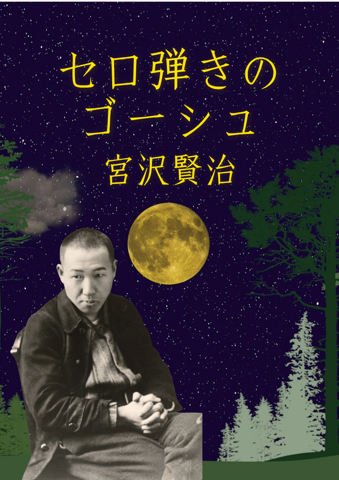
Background: The story depicts the repetitive practice of an unskilled musician as a series of nighttime dialogues with visiting animals. It highlights the connection between music, labor, and responding to others, noting that it was published posthumously. Understanding the era of its creation and the history of its publication makes it easier to see what the story and its expressions were responding to. Alternative titles found by readers should remain auxiliary information, with the standard title used consistently throughout the text.
Plot and Content: Gauche, who plays the cello at the town's cinema, is harshly reprimanded by the conductor for his lack of skill. Every night leading up to the concert, a cat, a cuckoo, a tanuki cub, and a field mouse visit his house, each responding to his playing in different ways. Rather than a detailed ending or character list, this serves as an entry point for reading the development and form of the text. The gap between what the narrator knows and what the reader can infer, as well as shifts in time through the arrangement of chapters and songs, serve as clues for interpretation.
Literary Features: In the repetitive structure of four nights, the cat, cuckoo, tanuki cub, and field mouse each draw out a different function of music. Onomatopoeia and dialogue allow the reader to imagine the performance by ear, showing Gauche's transformation through changes in reaction rather than through explanation. Checking the tone, pauses, and repetitions—which often disappear in summaries—clarifies the unique flavor of the work.
Encyclopedia of the Work
Author Biography: Kenji Miyazawa (1896–1933) was a poet and children's book author born in Iwate Prefecture, who was also involved in teaching at an agricultural school, agricultural guidance, and religious practice. He combined knowledge of geology, astronomy, music, and agriculture with a unique vocabulary and onomatopoeia to depict a world where humans, animals, the land, and the universe respond to one another. The books published during his lifetime centered on the poetry collection "Spring and Asura" and the story collection "The Restaurant of Many Orders," with many of his works organized from manuscripts after his death. Consequently, there may be different versions of titles and texts, making it essential to verify the source text.
Relationship between Author and Work: This work focuses Miyazawa's concern for music, labor, and animal life on the growth of a performer. Skill is not acquired suddenly by miracle, but changes through conflict, listening, and repetitive practice.
Media Comparisons (Last Decade): While not a direct adaptation, a thematic comparison can be made with the animated film "BLUE GIANT" (2023). Both works depict practice, ensemble playing, and the relationship with listeners, but this work features allegorical interactions with animals, while the film emphasizes urban jazz and the physicality of the stage. Specify the work title and year, and if it is not a direct adaptation, state it as a thematic comparison while comparing differences in focus based on medium and era.
Publisher
BookAI
Published
2026-09-16
Miva: the next reading experience beyond audiobooks
Listen like an audiobook, then ask anything, anytime.