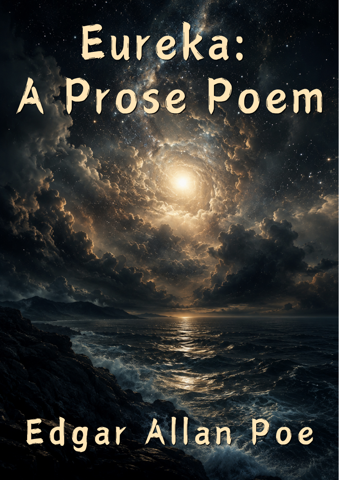
The Final Work of America's Master of the Macabre
The Prose Poem That Foresaw the Big Bang — Eighty Years Ahead of Science
Praised by Einstein and Carl Sagan as an Extraordinary Feat of Imagination
The Quiet Ancestor of a Century of Cosmic Literature
In one slim volume, a dying poet mapped the birth and death of the universe. You will read it in an evening—and never look at the night sky the same way again.
Published in 1848, only a year before Edgar Allan Poe's death, Eureka: A Prose Poem is one of the most extraordinary and misunderstood works in American literature. Neither a conventional scientific treatise nor a work of fiction, Poe called it a "prose poem," believing its purpose was not merely to present facts, but to reveal the hidden unity of the universe. Beginning with a rejection of blind reliance on accepted scientific authority, Poe proposes that the universe originated from a single primordial particle that explosively expanded into the cosmos before gradually collapsing back into unity — more than eighty years before the Big Bang theory was ever formulated.
What Poe constructed was not merely speculation. It was an act of imaginative cosmology: a finite, evolving universe rather than an eternal, static one; gravity as the force governing all matter's eventual reunion; a darkened night sky as evidence of a universe with a beginning. The book was met with bewilderment upon publication, dismissed by many as the eccentric fantasy of a dying writer. Today, it is read not as prophecy, but as proof that imagination can outrun the science of its own time.
"Eureka represents the culmination of Poe's lifelong attempt to unite poetry, philosophy, and science into a single vision of reality — his boldest intellectual achievement." —Harold Bloom, literary critic
The work has attracted admiration from generations of influential minds. Albert Einstein reportedly regarded Poe as possessing a remarkably independent mind, while astronomer Carl Sagan praised Eureka as an extraordinary example of imaginative reasoning, crediting Poe with grasping the core elements of modern cosmology with striking foresight. Though rarely adapted to film or television due to its philosophical density, its influence quietly runs through the tradition of cosmic literature — paving the way for H. P. Lovecraft, Olaf Stapledon, Arthur C. Clarke, and Jorge Luis Borges, all of whom explored humanity's place within an immeasurable universe.
"The Universe is a plot of God." Eureka is a short book you will finish in an evening. You will spend the rest of your life looking up.
Miva: the next reading experience beyond audiobooks
Listen like an audiobook, then ask anything, anytime.
Start Miva's narrationMiva does not just narrate. It keeps explaining based on what you ask.