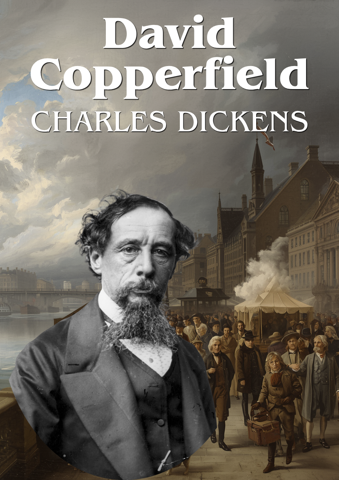
David Copperfield by Charles Dickens is a classic bildungsroman, first published serially in 1849-1850. Narrated by the protagonist himself, the novel chronicles David's journey from a naive orphan to a mature and successful author in Victorian England. His early life is marked by tragedy and hardship, including the cruel treatment from his stepfather, Edward Murdstone, and his sister Jane, after his mother's remarriage. This leads to his removal from home to a harsh boarding school and later, forced child labor in a London factory. David eventually escapes to the care of his eccentric but kind great-aunt, Betsey Trotwood. As he grows, David encounters a vibrant cast of characters who profoundly influence his life, including his loyal friend James Steerforth, the villainous and manipulative Uriah Heep, the devoted Agnes Wickfield, and the charming but impractical Dora Spenlow. Through experiences of friendship, betrayal, love, loss, and ambition, David strives to find his place in the world, ultimately reflecting on the formation of his character and identity.
Reading ease score: 78.7 (7th grade). Fairly easy to read.
David Copperfield’s life begins in Blunderstone, Suffolk, where he is born posthumously to his young, gentle mother, Clara. On the night of his birth, his eccentric, formidable great-aunt, Miss Betsey Trotwood, visits the house expecting a grand-niece to name after herself. When the doctor announces that the child is a boy, Miss Betsey leaves in a huff and vanishes from David’s early years. David grows up in a loving, tender environment alongside his mother and their loyal servant, Peggotty. However, this domestic tranquility shatters when his mother marries the stern and cruel Mr. Murdstone, who, together with his overbearing sister Miss Murdstone, enforces a cold regime of discipline. After David struggles under Murdstone’s tyrannical tutoring and bites his stepfather’s hand in self-defense, he is banished to Salem House, a grim boarding school managed by the abusive Mr. Creakle. There, David forms lasting friendships with the charming, aristocratic James Steerforth and the humble, good-natured Tommy Traddles. Soon after, tragedy strikes when his beloved mother and her newborn child pass away. Heartbroken and orphaned, David is removed from school by the Murdstones and sent at a tender age to endure brutal, soul-crushing labor at a wine-warehousing firm in London, Murdstone and Grinby. During this dreary period, he resides with the eternally optimistic yet chronically indebted Mr. Micawber and his family, witnessing their financial troubles and eventual imprisonment for debt. Desperate to escape his miserable condition, David flees London on foot, walking all the way to Dover to seek refuge with Miss Betsey Trotwood. The eccentric aunt, aided by her kindly companion Mr. Dick, takes him in, protects him from the Murdstones, renames him Trotwood Copperfield, and sends him to be educated in Canterbury. While staying in Canterbury with the lawyer Mr. Wickfield, David bonds with Wickfield's daughter, Agnes, who becomes his moral anchor and lifelong friend. He also encounters Uriah Heep, a sly, deceptively humble clerk who gradually gains control over Mr. Wickfield’s affairs through manipulation and deceit. As David grows into young adulthood, he pursues a legal career and falls passionately in love with Dora Spenlow, the charming but childish daughter of his employer. They eventually marry, though their early marital life is marked by practical difficulties due to Dora’s lack of domestic skills and David’s growing realization of her emotional fragility. Meanwhile, David works relentlessly as a shorthand reporter and author to build a stable career. Tragedy ripples through his circle when Steerforth seduces and runs away with Little Em’ly, the adopted niece of Peggotty’s brother, devastating the Yarmouth family. Mr. Peggotty embarks on a relentless search across Europe, eventually rescuing Emily from poverty and sorrow. Concurrently, Mr. Micawber, employed by Uriah Heep, uncovers Heep's pervasive financial fraud against Mr. Wickfield and Miss Trotwood. With the help of Traddles, Micawber exposes Heep’s crimes, restoring Miss Trotwood’s stolen fortune and liberating Mr. Wickfield from his ruinous influence. Gratefully supported by David and Miss Trotwood, the Micawbers, Mr. Peggotty, and Emily emigrate to Australia to start fresh, productive lives. Tragedy again strikes David’s life when Dora falls gravely ill and dies, leaving him in deep grief. Soon after, a fierce storm off Yarmouth takes the lives of both Steerforth, who is shipwrecked, and Ham Peggotty, who dies trying to save him. Shattered by loss, David spends years traveling abroad in Europe to heal and mature. Upon his return to England, he realizes that his deep, enduring affection for Agnes Wickfield is the true love of his life. They marry, finding lasting domestic bliss and raising a family together. David achieves great literary success and lives a serene life surrounded by cherished friends and family, reflecting on a journey marked by hardship, growth, and moral redemption.
Whether I shall turn out to be the hero of my own life, or whether that station will be held by anybody else, these pages must show. To begin my life with the beginning of my life, I record that I was born (as I have been informed and believe) on a Friday, at twelve o’clock at night.David Copperfield. This iconic opening line immediately sets the central thematic conflict of the novel: the protagonist's struggle for self-determination and agency in defining his own destiny.
‘If you please, aunt, I am your nephew.’ ... ‘I am David Copperfield, of Blunderstone, in Suffolk—where you came, on the night when I was born, and saw my dear mama. I have been very unhappy since she died. I have been slighted, and taught nothing, and thrown upon myself, and put to work not fit for me. It made me run away to you. I was robbed at first setting out, and have walked all the way, and have never slept in a bed since I began the journey.’David Copperfield Miss Betsey Trotwood. This emotional climax marks David's desperate plea for refuge and family, representing a major turning point where he transitions from neglect and exploitation toward protection and education.
I now approach an event in my life, so indelible, so awful, so bound by an infinite variety of ties to all that has preceded it, in these pages, that, from the beginning of my narrative, I have seen it growing larger and larger as I advanced, like a great tower in a plain, and throwing its fore-cast shadow even on the incidents of my childish days.David Copperfield. Employing powerful dramatic foreshadowing, this passage demonstrates Dickens's narrative mastery by framing life's major tragedies as looming structures that color every preceding memory.
I will only add, to what I have already written of my perseverance at this time of my life, and of a patient and continuous energy which then began to be matured within me, and which I know to be the strong part of my character, if it have any strength at all, that there, on looking back, I find the source of my success.David Copperfield David analyzes the rigorous discipline. The passage encapsulates the Victorian morality of self-improvement and hard work, offering a candid insight into the psychological strength and habits of order that define David's personal evolution.
The novel features an accessible reading ease score suitable for seventh-grade readers and above, making its prose approachable despite its nineteenth-century origins. While the overall length of the book is substantial, Charles Dickens wrote the work in serial installments, which endows the narrative with engaging, episodic pacing. Modern readers typically find the vivid dialogue and colorful characterizations easy to follow, although navigating some of the period-specific legal terminology and Victorian social context may occasionally require patience.
The work is widely celebrated as one of Charles Dickens's greatest masterpieces due to its rich characterization, emotional depth, and brilliant exploration of human growth. As a seminal bildungsroman, it effectively blends autobiographical elements from Dickens's own life with profound social criticism regarding child labor, financial ruin, and class rigidities. Its enduring power lies in its universal themes of self-determination, resilience, and the lifelong search for genuine love and belonging.
Everything the narrative has been building toward converges in a powerful sequence of resolution, reckoning, and emotional renewal. The long-standing tensions surrounding Uriah Heep's manipulations, the haunting aftermath of the Yarmouth tragedy, and David's own search for lasting domestic happiness reach their ultimate culmination in the final chapters. Which long-buried secrets come to light, how justice is restored to those who suffered, and where David finally finds his true emotional home are precisely the profound payoffs worth experiencing directly within the text.
Yes, the novel is Charles Dickens's most explicitly autobiographical fiction, sharing even its protagonist's inverted initials. Key elements of the story reflect Dickens's actual childhood memories, including his father's imprisonment for debt and his own traumatic stint working in a blacking factory at a young age. Furthermore, David's later career as a shorthand court reporter and successful novelist directly mirrors Dickens's personal professional trajectory.
While David encounters several cruel figures, Uriah Heep serves as the primary villain of his adult years, defined by his insincere humility and scheming ambition. Earlier in David's life, his cold and abusive stepfather, Edward Murdstone, acts as the central oppressive force. Together, these characters represent the dual threats of systemic cruelty and deceptive malice that David must navigate on his path to maturity.
Betsey Trotwood acts as David's savior and surrogate mother after he runs away from his unbearable factory job in London. Though initially presented as an eccentric and rigid woman, her deep generosity, practical wisdom, and fierce devotion transform David's life completely. She funds his education, protects him from his stepfather, and continually offers grounded counsel throughout his young adult career.
Miva: the next reading experience beyond audiobooks
Listen like an audiobook, then ask anything, anytime.
Start Miva's narrationMiva does not just narrate. It keeps explaining based on what you ask.