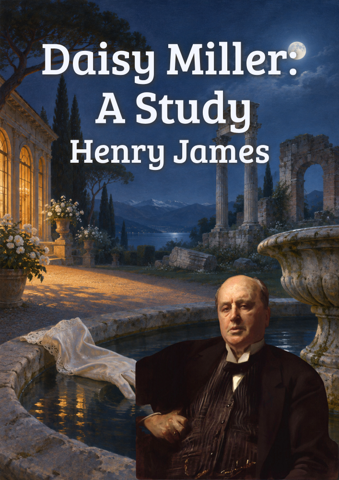
Background:
Published in book form in 1878, this novella stages the conflict between an independent young American traveler and the codes enforced by expatriate society in Europe.
The central tension:
Winterbourne tries to decide how to classify Daisy Miller's sociability and refusal of convention. His repeated acts of interpretation become as important as Daisy's conduct.
How the writing works:
Restricted viewpoint, social dialogue, irony, recurring acts of looking, travel settings, and the subtitle A Study make the book an examination of judgment rather than a neutral portrait.
Daisy Miller can be read in an evening, but it is difficult to finish the argument it starts. Daisy's behavior is visible to everyone; her motives are not. Winterbourne keeps trying to classify her as innocent, vulgar, reckless, or calculating, and each label reveals the Europeanized social code through which he looks. The subtitle A Study quietly turns the observer into part of the specimen.
James builds tension from walks, visits, introductions, and rules about where an unmarried woman may appear. Because the incidents are small, the force of reputation becomes unmistakable: no single act determines Daisy's meaning, yet repeated interpretation produces consequences. The restricted viewpoint also denies readers the comfort of standing entirely outside Winterbourne's error.
The 1974 film preserves the period setting and much of the social outline, but visible performance inevitably gives Daisy a psychological continuity the novella keeps contested. Readers should watch how often Winterbourne asks what Daisy 'really' is and how rarely the narrative confirms him. That gap is the source of the work's modern energy.
Daisy speaks freely, travels with insufficient supervision, and refuses to display the social anxiety expected of a young American woman abroad. None of those facts settles whether she is innocent, reckless, strategic, or simply bored by rules that make no sense to her. Winterbourne's repeated classifications create the story's real pressure. He is attracted to Daisy but relies on the same code that makes genuine knowledge of her impossible.
James uses small incidents because reputation is built from them: a walk, an introduction, an evening visit, a choice of companion. Each can be narrated as evidence by observers who already know the verdict they prefer. The restricted point of view never gives Daisy a private chapter that would rescue the reader from uncertainty. This formal refusal keeps the novella fresh. It is at once a swift social drama and a study of how interpretation becomes an action with consequences for the person interpreted.
Its brevity makes the novella ideal for rereading, and rereading changes the balance of blame. A first pass may focus on Daisy's provocations; a second notices Winterbourne's delays, borrowed judgments, and preference for classification over commitment. James never settles the case because the desire to settle it is itself under examination. Readers who like compact books that generate disproportionate discussion will find here a complete social world built from a handful of encounters—and a devastating demonstration that hesitation can be a form of action.
Director: Peter Bogdanovich
Production country: United States
Cast: Cybill Shepherd, Barry Brown, Cloris Leachman
Difference from the book: retains the period setting but converts Winterbourne's interpretive distance into visible behavior and compresses the novella's social commentary.
Often collected under the short or full title, the novella should be distinguished from stage and screen rewritings that sharpen its unresolved judgments.
Its brevity and ambiguity make the work a durable introduction to James's international theme and to the way reputation can be produced by observers who mistake classification for knowledge.
Miva: the next reading experience beyond audiobooks
Listen like an audiobook, then ask anything, anytime.
Start Miva's narrationMiva does not just narrate. It keeps explaining based on what you ask.