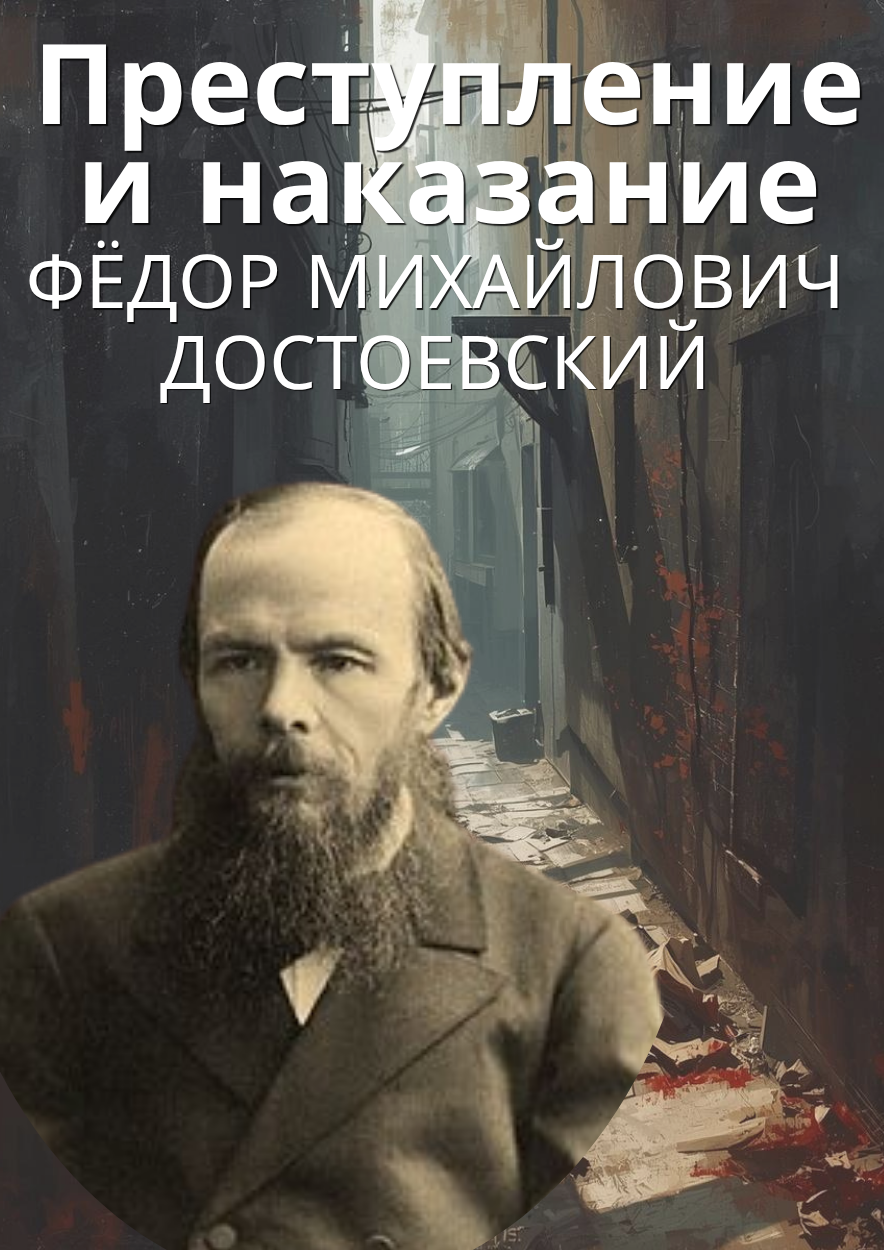
**The Opening Volume of Dostoevsky's Great Pentateuch**
**Written in Financial Ruin • Dictated to the Woman Who Would Become His Wife**
**The Novel That Defined Psychological Fiction — Studied by Nietzsche, Camus, and Freud**
*A student in a St. Petersburg garret develops a theory: that extraordinary people have the right to transgress ordinary moral law. He decides to test it. The test takes the rest of the novel to fail.*
---
In 1865, **Fyodor Dostoevsky** was drowning in debt, racing against a predatory publishing contract that would strip him of his rights if he missed the deadline, and dictating his manuscript to a stenographer named **Anna Snitkina**—who would become his wife before the book was finished. The conditions could not have been more desperate. The novel that emerged from them could not have been more precise.
***Crime and Punishment*** begins with an idea. **Rodion Raskolnikov**—former student, current inhabitant of a suffocating St. Petersburg garret—has constructed a theory as elegant as it is lethal: that humanity divides into the ordinary, who must obey the law, and the extraordinary, who have the right to transgress it in service of a greater purpose. Napoleon crossed boundaries. So did all the great men of history. The question Raskolnikov cannot stop asking is whether he belongs among them.
He decides to find out. He murders an elderly pawnbroker. The theory predicts triumph. What follows is its complete and systematic destruction—not by external punishment, but by the unbearable weight of his own psychological reality.
---
*"Pain and suffering are always inevitable for a large intelligence and a deep heart."*
*—Fyodor Dostoevsky, Crime and Punishment*
---
What **Dostoevsky** invented in this novel—and what literary scholars have called the **polyphonic** structure, the novel-as-tragedy—was a narrative architecture in which no single voice holds authority. Raskolnikov's theory is presented with genuine intellectual force. It is not dismissed. It is inhabited, tested, and dismantled from the inside. The result is something more devastating than any external moral verdict: the demonstration that the theory was always a symptom, never a philosophy.
St. Petersburg itself functions as a character—a suffocating, fever-yellow city of cramped garrets and airless rooms, where the wallpaper seems to press inward and the heat of summer makes madness feel inevitable. The city does not cause Raskolnikov's crisis. It mirrors it, amplifies it, and refuses to let it breathe.
---
**Nietzsche** studied the novel and recognized in Raskolnikov a preview of his own *Übermensch* argument—and its limits. **Albert Camus** returned to it repeatedly in his explorations of absurdism and moral revolt. **Freud** found in Raskolnikov's psychological unraveling a case study that anticipated the entire discipline of psychoanalysis. The novel has been adapted for film more than twenty times across as many countries—from **Lev Kulidzhanov**'s classic Soviet version in 1969 to contemporary retellings that transplant Raskolnikov's crisis into the 21st century without losing a single degree of its intensity.
The questions ***Crime and Punishment*** asks have not become historical. They have become more urgent: what is the relationship between intelligence and moral accountability? Does exceptional vision confer exceptional license? And what does a person do when the idea they have staked their identity on turns out, in the moment of its execution, to be wrong?
*Raskolnikov thought the hardest part would be the crime. It was not the crime.*
---
Miva: the next reading experience beyond audiobooks
Listen like an audiobook, then ask anything, anytime.
Start Miva's narrationMiva does not just narrate. It keeps explaining based on what you ask.