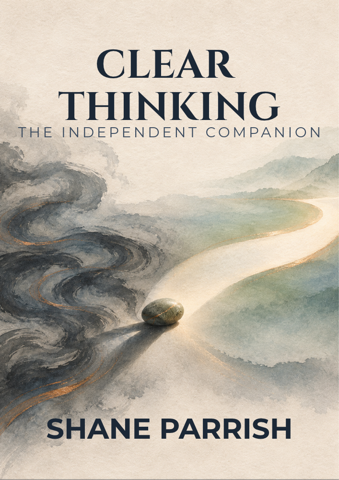
Most costly decisions do not announce themselves as turning points. Shane Parrish focuses on the ordinary moments when emotion, ego, social pressure, or habit takes control before deliberate thought has a chance to begin.
Instant New York Times Bestseller; 2023 Non-Obvious Book Awards Longlist; 2024 Non-Obvious Book Awards Psychology Shortlist.
Parrish argues that decisive moments are usually won or lost before they arrive. Four defaults—emotion, ego, social pressure, and inertia—shape automatic reactions, while strength, self-knowledge, and environmental safeguards create room for deliberate choice. The later chapters turn from defense to execution: defining the real problem, clarifying the desired outcome, examining options, setting decision criteria, and learning without confusing a lucky result with a sound process.
Readers can distinguish emotional, ego, social, and inertia defaults and identify the environments in which each is most likely to take over.
The book treats good judgment as preparation: habits, exemplars, rules, and safeguards matter because a difficult moment leaves little time to improvise character.
The guide highlights problem framing, desired outcomes, options, and standards so that speed does not become a substitute for clarity.
The useful thread is preparation. Readers can follow how exemplars, rules, habits, positioning, and margins of safety reduce dependence on willpower. The book also invites a demanding comparison between the author’s memorable stories and the actual scope of the principle they illustrate, which makes it productive for decision journals and leadership discussions.
This is strongest for professionals making repeated judgments under pressure, readers of mental-model literature, and teams that want a shared vocabulary for post-decision review. It is less a catalogue of clever biases than a practical architecture for behaving well when instinct arrives first.
Edition notice: This is an independent chapter guide and summary, not the original book. It is designed for review and reading support and is best used alongside the full work.
Miva: the next reading experience beyond audiobooks
Listen like an audiobook, then ask anything, anytime.
Start Miva's narrationMiva does not just narrate. It keeps explaining based on what you ask.