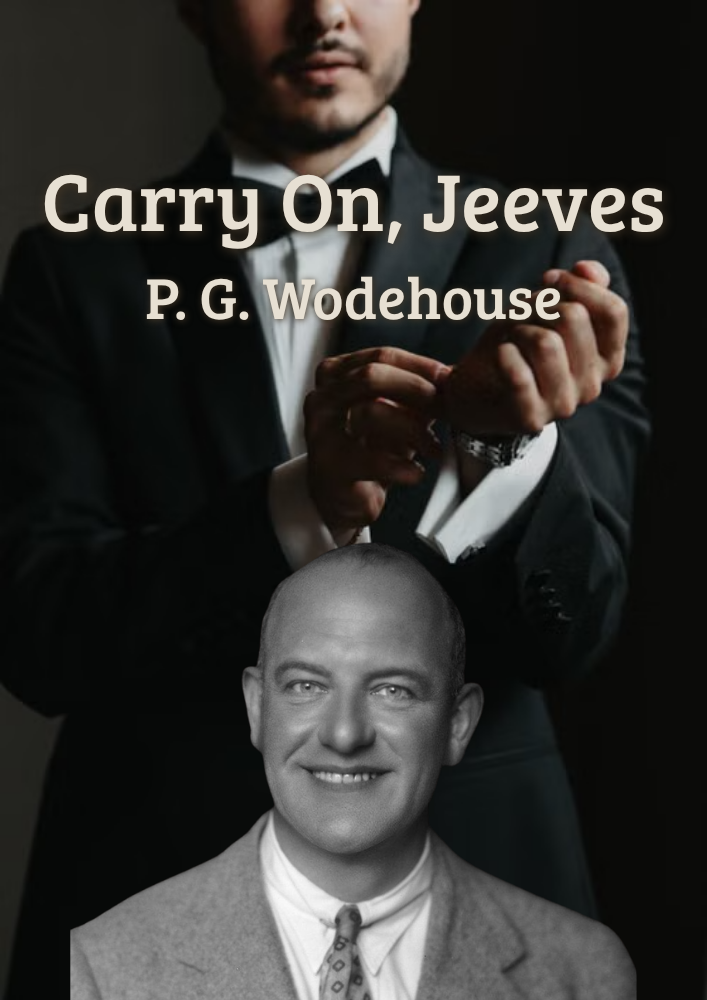
Background: In post-war British society, class etiquette and country house culture remained, but their authority could be lightheartedly dismantled through comedy. Wodehouse transformed the decency, awkwardness, and emotional troubles of high society into high-density wit. The emergence of Carry On, Jeeves connects threads of British humor, Jeeves, comedy, class, Wodehouse, and short story collections. It does not treat the era as mere decorative background, but allows social shifts, class pressures, post-war spirit, or a sense of the modern city to enter the characters' tones, choices, and silences. Readers can thus understand why this work resonated in its time and see the cultural issues it addresses.
Synopsis: Bertie Wooster is constantly lost amidst friends, relatives, engagements, and social disasters, while his valet, Jeeves, tidies up the situation with calm, precision, and almost magical arrangements. This book collects several Jeeves stories, showcasing the classic rhythm of the duo's partnership. As the stories progress, Carry On, Jeeves relies not only on plot twists but also on character relationships, shifts in perspective, and the accumulation of scenes to build tension. Readers follow the main characters into predicaments of romance, travel, family, social life, or spiritual exploration, gradually seeing how surface order is swayed by desire, memory, duty, and misunderstanding. Core plots are preserved here while avoiding premature spoilers of the most critical endings.
Literary Features: Readers can enjoy the linguistic speed of British humor while observing how class comedy uses laughter to handle power, etiquette, and male incompetence. It is a breath of fresh air in a list of heavy modernist books. Regarding literary features, what makes Carry On, Jeeves noteworthy is not an abstract "classic" status, but how it utilizes narrative rhythm, symbolic imagery, character voices, and structural arrangements to make loneliness, disillusionment, or spiritual crises a tangible reading experience. It is also suitable for reading alongside other modernist, Jazz Age, and post-war literary works to observe how different authors handle the individual within a fractured era.
Encyclopedia
Author's Life: P. G. Wodehouse (1881–1975) was a British humorist, playwright, and lyricist, most famous for the Jeeves and Wooster series. His work is built upon misunderstandings, social disasters, class etiquette, romantic troubles, and precise reversals, with a linguistic rhythm that is brisk and highly sophisticated. Wodehouse’s comedic world may seem far removed from the weight of politics and history, yet it preserves the musicality of British humor with supreme skill, allowing readers to feel the pleasure of order being rearranged within absurd situations. His writing belongs not only to entries of famous authors in literary history but is also frequently revisited in university courses, book clubs, and cross-cultural discussions; the narrative forms, character psychology, and social observations in his work still provide valid entry points for understanding modern life.
Relationship between Author and Work: P. G. Wodehouse was able to write Carry On, Jeeves due to his era, creative concerns, and literary ambitions. This work concentrates the long-term interests of the author—British humor, Jeeves, comedy, class, Wodehouse, and short story collections—and transforms them into readable experiences through specific characters and narrative forms. It is not a simple projection of the author's life, but the result of the author combining personal observation, the pressures of the times, and formal experimentation. Therefore, when reading this book, it is best to pay attention to both the author's background and how the text reforges that background into literary form.
Miva: the next reading experience beyond audiobooks
Listen like an audiobook, then ask anything, anytime.
Start Miva's narrationMiva does not just narrate. It keeps explaining based on what you ask.