One of the Absolute Peaks of European Decadentism
The Greatest Example of Italian "Musical Poetry"
Inspired by Eleonora Duse, the Actress Behind Ermione
Still Taught Today as the Perfect Fusion of Word and Nature
Rain falls on a pinewood. By the end of the poem, you can no longer tell where the human voice ends and the forest begins.
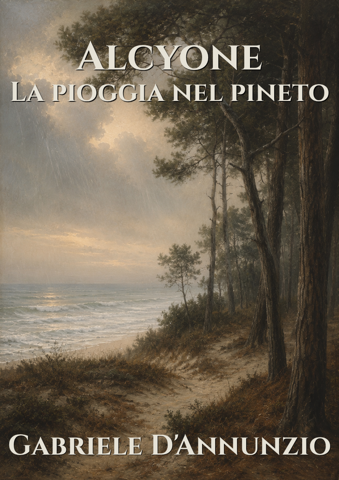
Composed probably between July and August 1902 in the pine forest of Versilia, near Marina di Pietrasanta, and published in 1903 in the collection Alcyone, The Rain in the Pinewood follows the poet and his beloved Ermione—a figure inspired by actress Eleonora Duse—as they walk through a pinewood while a summer rain falls slowly on the leaves.
What Gabriele D'Annunzio constructed was not merely a nature poem. It was a single sonorous and sensual substance, fusing rain, wind, trees, and human body until they become indistinguishable. The true protagonist is metamorphosis itself: human faces turn plant-like, the sounds of rain take on the rhythm of musical instruments, and the entire landscape becomes a vast living orchestra—a panicked fusion of human being and nature drawn from Nietzsche's philosophy, French Symbolism, and Decadent aestheticism. D'Annunzio builds the poem like a musical score, where alliteration, repetition, and onomatopoeia imitate the rain falling differently on tamarisk, pine, myrtle, and juniper—language pushed until it becomes pure sound, almost song. In its opening lines, the poet asks his beloved for silence, urging her to set human speech aside so that nature's own hidden voice can be heard.
Many critics have considered it the greatest example of Italian "musical poetry," its influence extending to Symbolist and Decadent writers, and beyond literature to musicians, directors, and visual artists.
—On the poem's place in twentieth-century European poetry
Over time, The Rain in the Pinewood has been adapted into stage performances, dramatic readings, radio programs, and musical compositions devoted to the text's musicality. It remains a symbol of Italian literature worldwide, still studied today in schools and universities as a perfect example of the fusion of poetic word, sensuality, and nature.
The rain never stops falling in this poem. What stops, instead, is the boundary between the people listening to it.
Miva: the next reading experience beyond audiobooks
Listen like an audiobook, then ask anything, anytime.
Start Miva's narrationMiva does not just narrate. It keeps explaining based on what you ask.