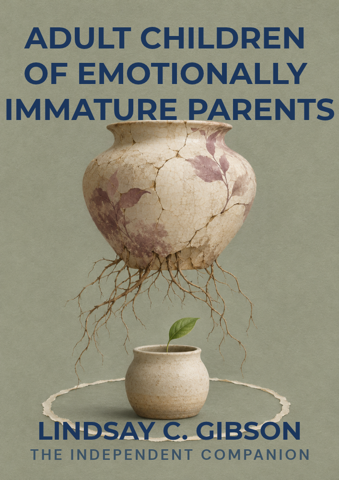
Why can a conversation with a parent leave an adult feeling unseen, guilty, or responsible for everyone else’s emotions? Lindsay C. Gibson gives readers a vocabulary for recognizing emotional immaturity without turning every difficult relationship into a diagnosis.
Gibson’s most useful shift is from asking how to win a parent’s approval to asking what that parent can realistically give. That change reduces the pressure to explain, rescue, or perform a familiar family role. As the chapters move from recognition to boundary-setting, readers can compare remembered interactions with the book’s markers of empathy, reciprocity, and self-reflection without turning the categories into weapons.
The book distinguishes four recurring parental styles and contrasts internalizing with externalizing responses. It then moves from recognition to practical work: observing instead of rescuing, protecting one’s inner experience, setting limits, and seeking emotionally mature relationships.
The emotional stakes are practical: a reader may need to grieve the parent they hoped for while still deciding what kind of contact is possible now. Pay attention to the maturity-awareness exercises, because they turn an abstract family pattern into choices about disclosure, expectations, and recovery after difficult encounters.
Track the difference between occasional poor behavior and the repeated lack of empathy, reciprocity, and emotional availability described in the book.
See how children adapt by performing a role that keeps a family stable, and why adulthood can require recovering preferences and feelings that the role suppressed.
Connect the book’s observational stance and maturity-awareness exercises to concrete choices about contact, expectations, and emotional labor.
A responsible application starts small. Instead of confronting a parent with a label, a reader can test one boundary, share less vulnerable information, or observe whether a request is acknowledged. The result supplies new evidence about the relationship. This approach protects the reader from turning insight into another exhausting attempt to force change in someone who has shown little capacity for it.
Useful for readers examining family patterns or practicing boundaries. It is educational reading, not a diagnosis of a parent or a substitute for individualized mental-health care.
Edition notice: This is an independent chapter guide and summary, not the original book. It is designed for review and reading support and is best used alongside the full work.
Miva: the next reading experience beyond audiobooks
Listen like an audiobook, then ask anything, anytime.
Start Miva's narrationMiva does not just narrate. It keeps explaining based on what you ask.