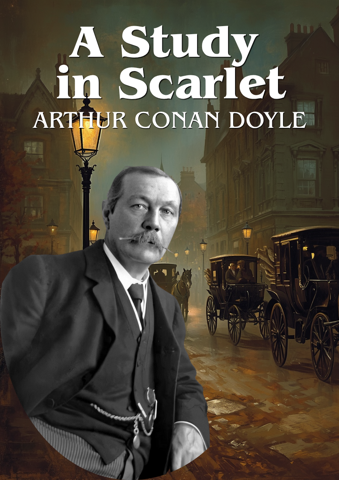
"A Study in Scarlet" by Arthur Conan Doyle is a groundbreaking detective novel published in 1887. This work famously introduces the iconic characters of Sherlock Holmes and Dr. John Watson, marking their first appearance as they embark on a perplexing investigation in London. The story begins with the discovery of a man's body in an abandoned house, with the enigmatic word "RACHE" (German for "revenge") scrawled in blood on the wall nearby. Holmes, with his unparalleled powers of deduction, must unravel the intricate threads of this murder. The investigation leads him and Watson through the dark underbelly of Victorian London and eventually uncovers a dramatic tale of revenge that spans two continents, connecting the London crime scene to a tragic series of events in Utah's Salt Lake Valley decades earlier. It's a foundational work in the detective fiction genre, establishing many of the tropes and character dynamics that would define future mysteries.
Reading ease score: 80.2 (6th grade). Easy to read.
A Study in Scarlet begins with Dr. John H. Watson meeting the eccentric "consulting detective" Sherlock Holmes in London. The two take up residence together at 221B Baker Street, where Watson witnesses Holmes’s extraordinary powers of observation and deduction firsthand. Their routine is broken when Inspector Gregson of Scotland Yard requests Holmes's aid in a bizarre murder case at 3 Lauriston Gardens. Inside a vacant, dilapidated house, the body of an American, Enoch J. Drebber, is discovered. Though surrounded by blood, the corpse bears no visible wounds. On the wall, written in blood, is the German word "RACHE" (meaning revenge). Holmes meticulously examines the crime scene, deducing key traits of the killer: a tall, florid-faced man with small feet, long fingernails, who smokes Trichinopoly cigars and arrived in a four-wheeled cab. Nearby, a woman's wedding ring is found. Holmes uses a public advertisement regarding the ring as a trap, which leads to a accomplice escaping in disguise. Shortly after, Inspector Lestrade discovers Drebber’s secretary, Joseph Stangerson, murdered in his hotel room, stabbed in the heart, with the word "RACHE" again scrawled above him. Among Stangerson's belongings, Lestrade finds two peculiar pills. Holmes tests these on an ailing terrier; while the first pill has no effect, the second instantly kills the dog, proving the weapon in Drebber's death was a lethal South American poison. Holmes then summons a street cabman under the guise of needing assistance with luggage. When the driver arrives at Baker Street, Holmes swiftly handcuffs him, revealing him to be Jefferson Hope, the murderer. At the police station, Hope, suffering from a fatal aortic aneurysm, willingly reveals the tragedy behind his vengeance. Decades earlier in Utah, John Ferrier and his adopted daughter, Lucy, were taken in by a Mormon community. As Lucy grew into adulthood, she fell in love with Jefferson Hope, a frontier hunter. However, Mormon leaders pressured John Ferrier to marry Lucy to one of their own, setting a strict deadline. Hope arrived just in time to help Ferrier and Lucy flee through perilous mountain passes. While Hope was away hunting for food, the "Avenging Angels", a sinister Mormon faction, tracked the fugitives down. They murdered John Ferrier and captured Lucy, forcing her to marry Enoch Drebber. Heartbroken, Lucy died within a month. Hope snuck into her vigil to kiss her forehead and retrieve her wedding ring before fleeing into the wilderness. He vowed to devote the rest of his life to punishing Drebber and his accomplice, Stangerson. For years, Hope pursued the two men across North America and Europe, finally tracking them to London. Working as a cab driver to monitor their movements, Hope cornered a intoxicated Drebber in the abandoned house on Brixton Road. He forced Drebber to choose between two pills, one harmless and one deadly poison, taking the remaining pill himself to let fate decide. Drebber selected the poisoned pill and perished. Days later, Hope confronted Stangerson in his hotel room with the same choice; when Stangerson attacked him, Hope stabbed him in self-defense. The night after his arrest, Jefferson Hope dies peacefully in his cell from his burst aneurysm, escaping execution. Back at Baker Street, Holmes explains his backward-reasoning method to Watson, demonstrating how every physical clue formed an unbreakable logical chain. Although newspaper reports give full credit for solving the mystery to the Scotland Yard inspectors Gregson and Lestrade, Watson resolves to publish his own detailed narrative of the case to ensure Holmes receives the recognition he truly deserves.
There’s the scarlet thread of murder running through the colourless skein of life, and our duty is to unravel it, and isolate it, and expose every inch of it.A Study in Scarlet Chapter 4. This passage encapsulates the titular metaphor of the novel and summarizes Holmes's artistic, philosophical view of detective work as bringing order and clarity to human chaos.
From a drop of water, a logician could infer the possibility of an Atlantic or a Niagara without having seen or heard of one or the other.A Study in Scarlet Chapter 2. It serves as a striking and imaginative illustration of the power of deductive reasoning, establishing Holmes's intellectual framework for analyzing the world.
By a man’s finger nails, by his coat-sleeve, by his boot, by his trouser knees, by the callosities of his forefinger and thumb, by his expression, by his shirt cuffs—by each of these things a man’s calling is plainly revealed.A Study in Scarlet Chapter 2. It vividly demonstrates the specific observational techniques that define the iconic detective persona, emphasizing how minutiae reveal character and history.
I took the marriage ring from her dead finger, and I vowed that his dying eyes should rest upon that very ring, and that his last thoughts should be of the crime for which he was punished.A Study in Scarlet Part 2, Chapter 6. It captures the intense emotional drive and central tragic conflict of the story, transforming a simple murder mystery into a tale of relentless retribution.
Arthur Conan Doyle's novel is widely considered an accessible read, scoring high on standard readability scales with an average middle-school reading ease level. The prose is clear, direct, and fast-paced, focusing heavily on dialogue, physical action, and logical explanations. While the text contains nineteenth-century phrasing and vocabulary typical of Victorian popular fiction, the narrative structure remains straightforward. The story is divided into two distinct parts: the first half focuses on Watson's initial encounters with Holmes and the London murder investigation, while the second half shifts to an adventure-style narrative set in the American West before returning to Baker Street. This dynamic change of setting and tone keeps the plot moving swiftly, preventing the historical vocabulary from overwhelming the reader.
This novel is a cornerstone of mystery fiction because it introduced Sherlock Holmes and Dr. John Watson, establishing the definitive archetype for modern detective literature. Published in 1887, it popularized the concept of scientific deduction in crime-solving, shifting mystery narratives away from simple intuition toward logical analysis, forensic evaluation, and observation. The dynamic between the brilliant, eccentric detective and his grounded, inquisitive biographer created a template that has been adapted across countless books, television shows, and films. Beyond its influence on genre tropes, the book remains a classic due to its vivid depiction of Victorian London paired with a sweeping story of international vengeance.
The final section brings the complex threads of the investigation together as Sherlock Holmes lays out the complete chain of logical deduction that solved the crime. What awaits in these closing chapters is the full accounting of how a distant tragedy in the American West culminated in the Baker Street confrontation, followed by a quiet resolution regarding the killer's ultimate fate. The story concludes with Watson making a pivotal decision about how his friend's analytical genius will be presented to the world, cementing their partnership for future cases. Read these closing pages for yourself to experience the resolution.
The primary narrator of the story is Dr. John H. Watson, who recounts his first meeting with Sherlock Holmes and their subsequent investigation in a personal memoir format. Watson provides a first-person perspective that allows readers to observe Holmes's methods from the outside, sharing in the doctor's initial bewilderment and eventual understanding as clues are revealed. However, the novel briefly shifts perspective in its second half to an objective, third-person omniscient voice to detail the back-story events occurring decades earlier in Utah. The narrative eventually returns to Watson's first-person journal format for the concluding chapters in London.
During the investigation at the Brixton Road crime scene, Scotland Yard inspectors initially speculate that the blood-written letters spelling "RACHE" were intended as an unfinished spelling of the female name "Rachel." Sherlock Holmes corrects them by identifying it as the German word for "revenge." This clue serves as a primary marker throughout the investigation, establishing that the killings are not random acts of violence or robbery, but are instead part of a calculated, deliberate plot aimed at punishing specific individuals for past actions.
The novel's setting is split between two distinct geographical locations and time periods. The main mystery takes place in Victorian London during the late nineteenth century, focusing on sites such as 221B Baker Street, abandoned properties in Brixton, and local hotel rooms. The secondary narrative takes place decades earlier in the mid-nineteenth century, set against the vast, isolated wilderness of Utah's Salt Lake Valley and the surrounding mountain passes, tracing the origin of the conflict that later culminates in the London murders.
Miva: the next reading experience beyond audiobooks
Listen like an audiobook, then ask anything, anytime.
Start Miva's narrationMiva does not just narrate. It keeps explaining based on what you ask.