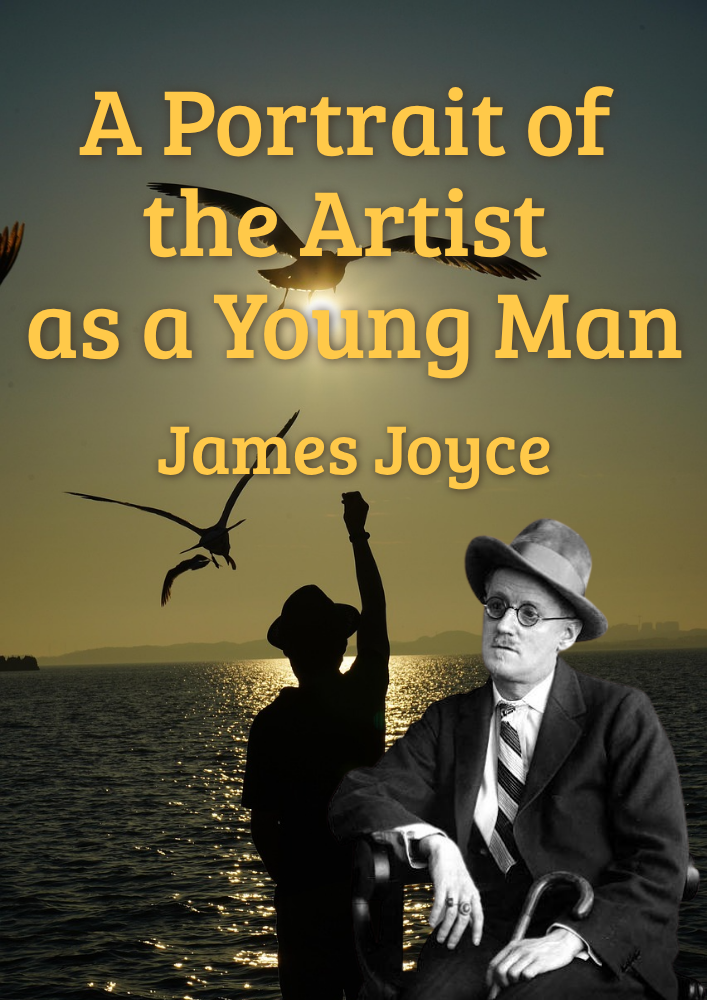
Background: Ireland searches for a modern identity in the shadows of religion, nationalism, and British rule. Joyce depicts the growth of a young artist as a gradual awakening of language, faith, and self-consciousness. A Portrait of the Artist as a Young Man connects contexts such as modernism, stream of consciousness, Irish literature, the Künstlerroman (artist's novel), the Bildungsroman (coming-of-age novel), and Joyce himself. It does not treat the era as mere decoration; instead, social flux, class pressure, post-war spirit, and the sense of the modern city permeate the character's tone, choices, and silences. Readers can thus understand why this work resonated in its time and see the cultural questions it addresses.
Synopsis: Stephen Dedalus moves from childhood, school, and family conflict into young adulthood, experiencing guilt, religious fear, intellectual rebellion, and aesthetic awakening. He ultimately chooses to leave his familiar community, using art as a mode of self-naming and spiritual exile. As the story progresses, A Portrait of the Artist as a Young Man relies not only on plot twists but on shifts in character relationships, perspectives, and the accumulation of scenes to create tension. Readers follow the protagonist into dilemmas of romance, travel, family, social life, or spiritual exploration, gradually seeing how surface order is driven by desire, memory, duty, and misunderstanding. Core plots are preserved here, while avoiding premature spoilers of the most critical ending impacts.
Literary Features: Readers can observe the intersection of stream of consciousness and the Bildungsroman, seeing that modernism is not just a formal experiment but a difficult exercise in an individual breaking free from the summons of family, church, and nation. In terms of literary characteristics, what is noteworthy about A Portrait of the Artist as a Young Man is not its abstract "classic" status, but how it utilizes narrative rhythm, symbolic imagery, character voices, and structural arrangements to make loneliness, disillusionment, or spiritual crisis a tangible reading experience. It is also suitable for reading alongside other modernist, Jazz Age, and post-war literary works to observe how different writers handle the individual in a fragmented era.
Encyclopedia of the Work
Author Biography: James Joyce (1882–1941) was a central figure in Irish modernist literature, exerting a profound influence on twentieth-century novel forms. He excelled at using linguistic experimentation, stream of consciousness, mythological structures, and urban detail to describe the flow of the individual mind, and he shaped Dublin into one of the most important cities in modern literature. Joyce's work frequently deals with family, religion, national identity, exile, and the artist's self-creation. While the barrier to entry is not low, his work allows readers to see the power of novelistic language being reinvented. His creation does not merely belong to a list of famous names in literary history; it is often reread in university courses, book clubs, and cross-cultural discussions. The narrative forms, character psychology, and observations of the era in his work still provide an effective gateway to understanding modern life.
Relationship Between Author and Work: James Joyce was able to write A Portrait of the Artist as a Young Man because of his era, creative concerns, and literary ambitions. This work concentrates long-standing interests of the author—modernism, stream of consciousness, Irish literature, the Künstlerroman, the Bildungsroman, and Joycean themes—and transforms them into a readable experience through specific characters and narrative forms. It is not a simple projection of the author's life, but the result of combining personal observation, contemporary pressures, and formal experimentation.
Film and Television Comparison (Last Decade): There have been no direct mainstream adaptations in the last decade, but it can be read alongside Kenneth Branagh's Belfast (2021) thematically. Both use a coming-of-age perspective to write about how family, religion, and local identity shape a child; the difference is that Belfast looks back at the Northern Ireland conflict through cinematic memory, while A Portrait of the Artist as a Young Man writes language, guilt, and aesthetic awakening into an internal history of an artist leaving home. This comparison helps readers distinguish the literary focus of the original and the reinterpretation of rhythm, visuals, character focus, and contemporary issues in the film medium, placing the classic back into today's viewing experience.
Miva: the next reading experience beyond audiobooks
Listen like an audiobook, then ask anything, anytime.
Start Miva's narrationMiva does not just narrate. It keeps explaining based on what you ask.