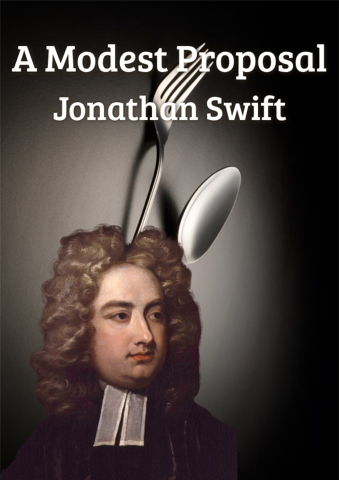
Background:
Jonathan Swift anonymously published this political satire in 1729, amid severe Irish poverty, landlord exploitation, and the economic effects of English rule. Its “modest proposal” imitates the calm voice of a practical policy paper while pushing dehumanizing economic reasoning to a horrifying extreme.
Story Summary:
A self-styled rational projector calculates the cost of poor families to the nation and offers a monstrous remedy. As his orderly argument proceeds, numbers and efficiency increasingly erase the human beings supposedly being helped.
Literary Form:
The essay depends on sustained irony. The speaker sounds measured, informed, and public-spirited, but the gulf between his manner and his proposal exposes the moral emptiness of the discourse he imitates. The fictional projector must not be confused with Swift: statistics, cost-benefit language, and philanthropic formulas are the objects of the satire.
No widely distributed feature film has been confirmed as a representative direct narrative adaptation. The work is more often encountered through readings, short films, stage pieces, and contemporary satires that borrow its title or argumentative method.
Main Edition:
The original essay is short, but early spelling, Irish political history, and period calculations matter. A good reading edition preserves the complete text and supplies concise historical notes. Abridgment is especially damaging because the satire depends on the speaker escalating his logic while maintaining the same reasonable tone.
Reading Recommendation:
Read the whole essay before extracting any statement as Swift's opinion. Comparison with his other writings on Ireland makes clear that his true target is a political language that treats impoverished people as burdens and commodities.
Cultural Significance:
The essay remains a model of English prose satire. The phrase “a modest proposal” still signals an apparently reasonable suggestion designed to expose institutional absurdity. The work also poses an enduring ethical question: what happens when formally impeccable reasoning excludes sympathy and human dignity?
Miva: the next reading experience beyond audiobooks
Listen like an audiobook, then ask anything, anytime.
Start Miva's narrationMiva does not just narrate. It keeps explaining based on what you ask.