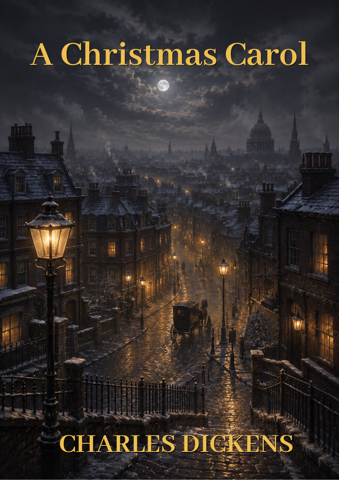
“A Christmas Carol; Or, The Miser's Warning!” by C. Z. Barnett and Charles Dickens is a 19th-century theatrical adaptation of Dickens's renowned novella. This drama, set in the Victorian era, explores themes of redemption, the true spirit of Christmas, and the profound moral transformation of its protagonist, Ebenezer Scrooge. The narrative follows Scrooge, a cold-hearted miser who despises Christmas. On Christmas Eve, he is visited by the ghost of his deceased business partner, Jacob Marley, who warns him of impending visits from three spirits: Christmas Past, Present, and Future. These spectral encounters force Scrooge to confront his lonely childhood, witness the hardships faced by others, including his employee Bob Cratchit, and ultimately face the grim prospect of his own legacy. These revelations ignite a sense of compassion and responsibility within him, leading to a joyful transformation. Scrooge vows to embrace the festive spirit, support those in need, and emerges as a benevolent figure, embodying the true essence of Christmas and generosity.
Reading ease score: 85.7 (6th grade). Easy to read.
In C. Z. Barnett's dramatic adaptation, A Christmas Carol; Or, The Miser's Warning!, Ebenezer Scrooge is portrayed as a cold, miserly man in London who openly despises the spirit of Christmas. On Christmas Eve, he rejects the warm holiday greetings and dinner invitation of his nephew, Frank Freeheart, expressing his belief that the poor should go to workhouses or prisons rather than receive charity. Scrooge begrudgingly allows his clerk, Bob Cratchit, a single day off for the holiday. Although Scrooge mistreats him, Bob remains generous in spirit, even offering some of his own tiny savings to charity collectors. Later, when Scrooge receives news that Frank faces financial ruin, he shows no sympathy. Returning home to his cold chambers, Scrooge is confronted by the ghost of his deceased business partner, Jacob Marley. Heavy chains encircle Marley, representing the greed and selfishness of his earthly life. Marley warns Scrooge that a similar fate awaits him unless he changes his ways, revealing that three spirits will visit him to offer a final chance at redemption. The first spirit, the Ghost of Christmas Past, takes Scrooge through his previous years. Scrooge re-experiences his lonely childhood at school, the joy of his apprenticeship under the kind Mr. Fezziwig, and the tragic moment when his fiancée, Ellen, ended their engagement because his growing passion for wealth had eclipsed his love for her. Meanwhile, Bob Cratchit suffers a setback when a thief named Dark Sam steals his week's wages. However, Frank encounters the distraught clerk and gives him a sovereign, ensuring the Cratchit family, including young Tiny Tim, can enjoy Christmas dinner. Next, the Ghost of Christmas Present introduces Scrooge to current holiday celebrations. They visit a lighthouse and miners before arriving at Frank's festive house, where Frank defends his uncle and leads a toast to him, despite learning his fortune has been lost at sea. The spirit then takes Scrooge to the humble Cratchit home, where the family shares a small goose and pudding. Scrooge is moved by Tiny Tim's frail health, but the spirit uses Scrooge's past remarks about the "surplus population" to warn that the boy will die if the future remains unchanged. Before departing, the ghost reveals two wretched children hidden in his robes, Ignorance and Want. At midnight, the silent Ghost of Christmas Yet to Come replaces the second spirit and guides Scrooge into a dark future. They overhear callous businessmen discussing the death of an unloved, wealthy man. The phantom leads Scrooge to a pawn shop where looters, including a charwoman and undertaker's assistant, sell items stolen from the dead man's bedside. To escape these grim scenes, Scrooge asks to see tenderness, so the spirit reveals the Cratchit home in mourning over Tiny Tim's death. Finally, in a churchyard, the ghost points to a gravestone bearing Ebenezer Scrooge's own name. Realizing he was the unloved man, Scrooge falls to his knees, begging for mercy and promising to honor Christmas and live by the spirits' lessons. Scrooge awakens in his own bed on Christmas morning, ecstatic to discover he is alive and has time to make amends. Transformed, he immediately sends a large prize turkey to the Cratchit family. When Frank and Bob arrive, Scrooge surprises them with boundless generosity: he provides Frank with the funds needed to recover from financial ruin, promises him his inheritance, and trebles Bob's salary while pledging to help raise Tiny Tim. Embracing a life of charity and kindness, Scrooge earns forgiveness for his past and looks forward to a hopeful future.
If I could work my will, every idiot who goes about with merry Christmas on his lips should be boiled with his own pudding, and buried with a stake of holly through his heart—he should!A Christmas Carol; Or, The Miser's Warning! Act I, Scene 1. This iconic exclamation immediately establishes Scrooge's venomous misanthropy and contempt for human warmth, serving as the dramatic baseline for his character before his transformation.
I wear the chain I forged in life—I made it link by link. Is its pattern strange to you? Oh, no space of regret can make amends for one life's opportunities misused.A Christmas Carol; Or, The Miser's Warning! Act I, Scene 3. It encapsulates the central moral principle of the play, warning that personal choices have inescapable spiritual consequences while introducing the haunting supernatural urgency of the narrative.
Man—if man you be in heart, and not adamant—forbear that wicked cant until you have discovered what the surplus is, and where it is. Will you decide what men shall live—what men shall die?A Christmas Carol; Or, The Miser's Warning! Act II, Scene 2. This passage delivers a sharp ethical rebuke against viewing human lives as mere statistical abstractions, forcing Scrooge to confront the real human cost of his cold worldview.
I say it on my knees—on my knees! My cheek is wet with tears, but they are tears of penitence! I don't know what to do—I'm as light as a feather—I'm as happy as an angel—I'm as merry as a school-boy—I'm as giddy as a drunken man!A Christmas Carol; Or, The Miser's Warning! Act II, Scene 5. The ecstatic, child-like speech contrasts dramatically with Scrooge's earlier rigid miserliness, capturing the profound emotional relief and euphoric joy of genuine moral redemption.
This theatrical adaptation is exceptionally accessible and straightforward to read. The text has a reading ease score corresponding to approximately a 6th-grade reading level, making the dialogue and stage directions clear and easy to follow. Because the work is structured as a dramatic script with direct character lines and concise scene settings, readers can navigate the story swiftly without getting bogged down in complex Victorian prose. The language remains engaging and dramatic while retaining the classic charm of the era. Readers of almost any background will find the narrative pace brisk and the character interactions easy to understand.
The work remains a timeless classic because it articulates a universal human hope, which is the belief that no person is beyond moral renewal. By placing Ebenezer Scrooge in direct confrontation with his past choices, current social impact, and ultimate mortality, the play constructs a dramatic framework for profound internal change. The contrast between Scrooge's initial cynicism and his overwhelming relief upon awakening on Christmas morning resonates deeply with readers across generations. Furthermore, the story's emphasis on empathy, generosity, and social responsibility gives it an enduring ethical relevance that transcends its historical Victorian setting.
At the end of this journey, Ebenezer Scrooge is brought face to face with the final, inescapable ledger of his life. After witnessing the ghosts of his past and present, he is forced to step into a chilling silence where no excuses remain and every choice yields its ultimate harvest. What awaits in those closing scenes is not merely a resolution of plots or a settling of debts, but the raw, breathless moment where a hardened human spirit must decide whether to collapse under the weight of its own regret or risk everything on the desperate hope of transformation. It is a confrontation with destiny so profound that no reader leaves it unchanged.
While Charles Dickens wrote the original prose novella, this specific version is a 19th-century theatrical adaptation written by C. Z. Barnett for the stage. As a drama, it converts the narrative descriptions of the novella into spoken dialogue, stage actions, and theatrical scenes designed for live performance. The play introduces slight dramatic adjustments, such as giving Scrooge's nephew the full name Frank Freeheart and adding subplot details involving characters like Dark Sam, to heighten stage tension. Despite these minor theatrical adaptations, the play faithfully preserves the core plot, supernatural visits, and moral messages of Dickens's famous story.
The four supernatural visitors act as essential catalysts for Ebenezer Scrooge's psychological and spiritual awakenings. Jacob Marley establishes the initial moral danger, breaking through Scrooge's rigid cynicism with a visceral warning of eternal punishment. The Ghost of Christmas Past reawakens Scrooge's suppressed emotions by forcing him to remember lost joy and love. The Ghost of Christmas Present grounds him in current social reality, exposing him to the warmth and suffering of others. Finally, the Ghost of Christmas Yet to Come provides the decisive shock by revealing the bleak, unmourned culmination of a selfish life, compelling Scrooge to seek forgiveness.
Tiny Tim serves as the emotional heart of the narrative and the ultimate test of Ebenezer Scrooge's humanity. As the frail son of Bob Cratchit, Tiny Tim embodies innocence and vulnerability amidst severe economic hardship. When Scrooge witnesses the boy's gentle disposition during the family's modest Christmas dinner, he is forced to care about a child's fate. The 2nd Spirit's warning that Tiny Tim will die if the future remains unaltered turns Scrooge's abstract views on social inequality into a deeply personal crisis, compelling him to reject his former callousness and embrace active charity.
Miva: the next reading experience beyond audiobooks
Listen like an audiobook, then ask anything, anytime.
Start Miva's narrationMiva does not just narrate. It keeps explaining based on what you ask.